Few discoveries are as overwhelming as stumbling upon a decomposition scene in a home. Whether it’s a neighbor found too late, a family member who lived alone, or an unattended death that went undiscovered for days — the moment you realize what you’re looking at, panic sets in fast. What do you touch? Who do you call? Is it even safe to be standing in that room?
If you’re reading this because you’ve already found something, or you’re trying to prepare for the worst, this guide will walk you through every step: what to do immediately, what to avoid at all costs, how law enforcement fits into the picture, and why decomposition cleanup is never something untrained hands should attempt.
Your First 60 Seconds: Leave and Call for Help
This is the one rule that overrides everything else — do not go further into the space.
The urge to check on someone, to confirm what you’re seeing, or even to crack a window open is completely understandable. But a decomposition scene is an active biohazard environment. The air itself can carry harmful bacteria and volatile gases. Bodily fluids on the floor, furniture, or walls are invisible carriers for pathogens like hepatitis B, hepatitis C, and HIV — all of which can remain infectious on surfaces long after death.
Call 911 immediately. Emergency dispatch will contact law enforcement, and depending on the circumstances, the medical examiner’s office will be notified as well. Don’t try to confirm death yourself, and don’t move or touch anything near the scene. Even well-meaning actions — opening windows, removing a personal item — can compromise a potential investigation without you even knowing it.
Once you’ve made the call, get outside and wait at a safe distance. The next steps are not yours to handle alone.
Immediate Safety Steps While You Wait for Authorities
While waiting for first responders, there are a handful of things you can — and should — do to protect yourself and anyone else nearby.
- Keep others away from the area. If you’re in a shared building, stop other residents, staff, or neighbors from approaching the unit. Decomposition odors travel, and so can airborne contaminants, especially if an HVAC system has been running and circulating air through the space.
- Switch off shared air systems — only if you can do it safely from outside the room. Decomposition releases volatile organic compounds (VOCs) that travel through ventilation and can reach adjacent units or floors. If the air handler controls are accessible without entering the scene, turning it off limits further spread. If not, leave it alone and let the professionals handle it.
- Try to estimate how long the person may have been undiscovered. It sounds like an odd thing to think about in the moment, but this detail matters enormously — for the investigation and for the cleanup team that follows. The decomposition timeline changes everything about how the scene is handled.
On the timeline front, it helps to know what’s happening biologically. Within the first 24 to 72 hours, bacteria multiply rapidly and gases begin building up. After a week or more, bioaerosols are actively being released into the air, and structural materials like flooring and drywall may already be saturated with fluids. That window determines the scale of remediation ahead.
Ventilation Precautions: Why “Just Open a Window” Isn’t the Answer
The instinct after walking into a bad smell is to air the place out. It’s a natural response — but when it comes to decomposition scenes, improper ventilation can actually make the problem worse, not better.
Decomposition gases include ammonia, methane, hydrogen sulfide, putrescine, and cadaverine. These aren’t just unpleasant — in enclosed spaces, they can reach concentrations that cause respiratory irritation, headaches, nausea, and, in serious cases, real harm. Opening a window doesn’t neutralize any of them. It moves them around.
Professional biohazard cleanup teams use industrial-grade air scrubbers, HEPA filtration systems, and vapor-phase deodorization equipment to address decomposition odors at the source. Household fans, sprays, or candles accomplish nothing except temporarily masking a smell that signals ongoing biological activity. Until a certified team has assessed and secured the space, treat ventilation as a controlled, professional operation — not something to improvise.
Contamination Risks: Why the Danger Doesn’t Leave When the Body Does
This is one of the most common — and most dangerous — misconceptions families face: once the body is removed, the hazard is gone.
It isn’t.
What Gets Left Behind in Porous Materials
The human body during decomposition releases fluids that seep into everything around it — carpeting, subflooring, drywall, upholstery, baseboards. These materials don’t just smell bad. They become persistent reservoirs for pathogens. Bloodborne hazards like hepatitis B and C, along with bacteria including Staphylococcus aureus and Salmonella species, can survive in these materials well after the visible scene has been cleared.
And it’s not always obvious from the surface. Fluids wick downward and outward, often traveling several feet from where the body was found. What looks like a contained area rarely is.
Environmental Factors That Accelerate the Spread
Temperature and humidity play a significant role in how quickly contamination spreads and how severe the biohazard becomes:
- In warm environments, bacterial populations can double every 20 to 30 minutes, dramatically increasing pathogen concentration in a short window of time.
- Relative humidity above 60% accelerates mold growth on affected surfaces — adding a respiratory hazard on top of an already complex biohazard situation.
- A sealed room with no airflow speeds up decomposition and concentrates gases faster than a ventilated space.
There’s also the pest factor. Flies, insects, and in some cases rodents are drawn to decomposition scenes, and their activity introduces additional contamination pathways — including into wall cavities, under floorboards, and into ceiling materials that look completely untouched from the outside.
This is why professional assessment, not just a visual walkthrough, is essential after every unattended death.
Coordinating With Law Enforcement: What to Expect
Once law enforcement arrives, your role becomes mostly passive — and honestly, that’s a relief.
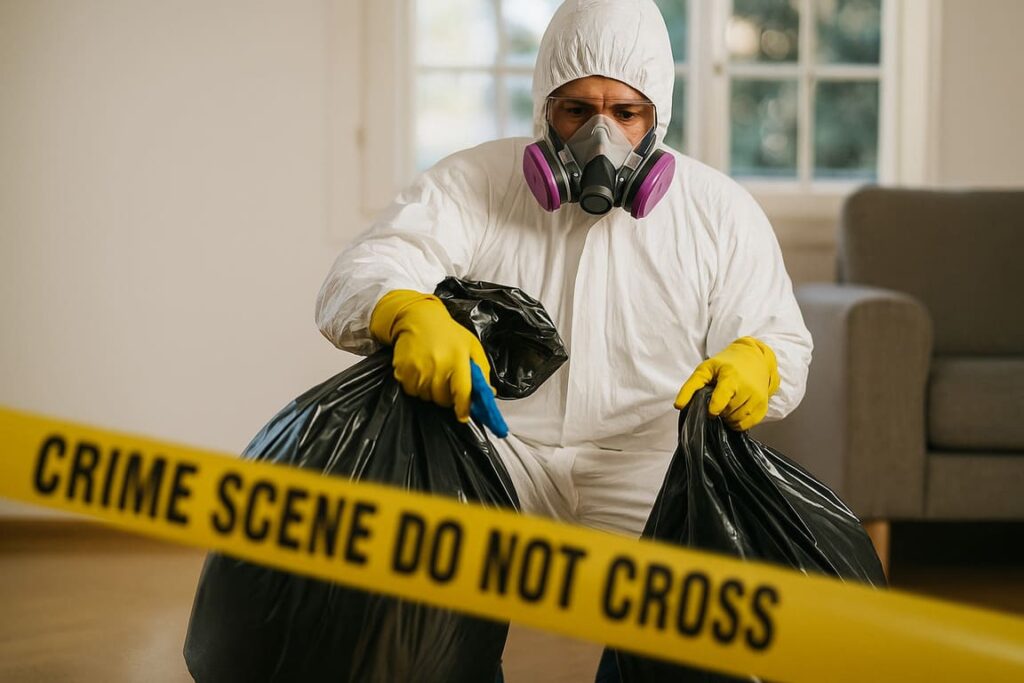
Police and detectives will assess whether the death was natural, accidental, or potentially criminal. Until that determination is made, the scene is treated as a potential crime scene. That means no one — not family members, not property managers, not neighbors trying to help — should enter or touch anything until the scene is officially released.
The medical examiner or coroner takes responsibility for the body. Once their work is complete, law enforcement issues a formal scene release. That release is your green light to contact a certified biohazard remediation company. Cleanup cannot legally begin before this point, and attempting it early can obstruct an active investigation.
A few practical things to take care of during this period:
- Get the case number. If you’re a property owner or manager, document the law enforcement case number as soon as it’s available. Most professional cleanup services and insurance providers will ask for it, and it establishes the official timeline for everything that follows.
- Don’t re-enter the property without clearance. Even after the body has been removed, the scene hasn’t been remediated. It’s still a biohazard environment.
- Contact your insurance provider early. Homeowner’s and renter’s policies often cover professional decomposition cleanup. Starting that conversation while law enforcement is still on-site can speed up approvals later.
When the scene is released, contact a professional service like Bio Recovery Pro right away. In decomposition situations, the longer the wait between scene release and remediation, the more structural damage accumulates.
Why DIY Decomposition Cleanup Is So Dangerous
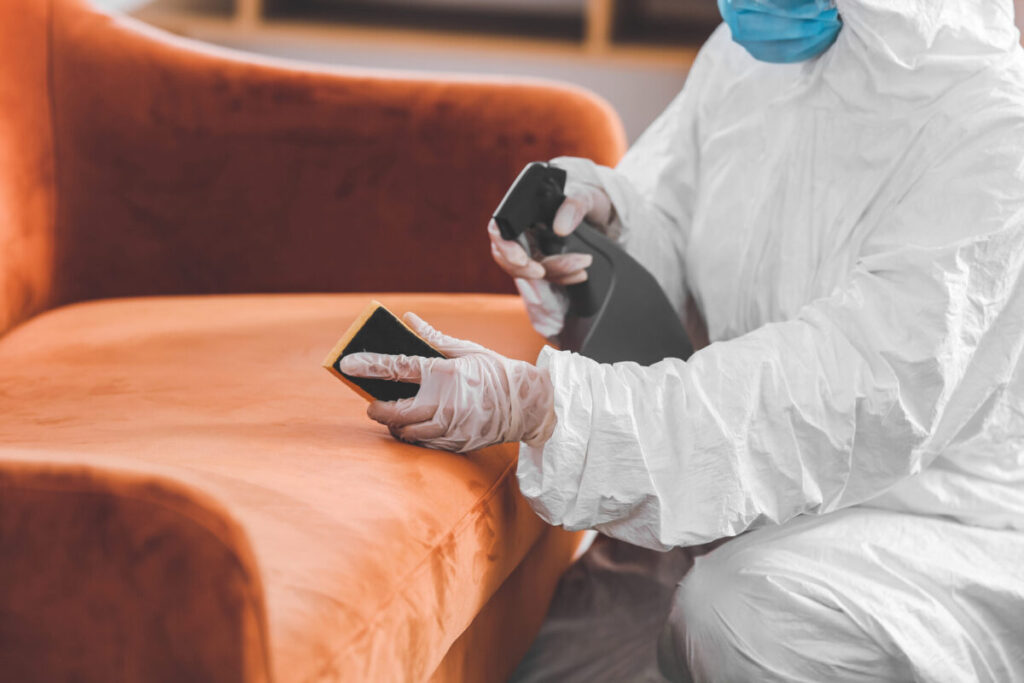
There are no two ways around this: attempting to clean a decomposition scene without proper training, equipment, and certification puts your health at serious risk — and in some states, improper disposal of biohazardous waste carries legal consequences too.
Here’s what DIY attempts almost always get wrong:
- Visible contamination is only a fraction of the actual problem. Fluids that have soaked into subflooring or walls don’t look like much from the surface. Without moisture meters, UV lighting, and targeted swab testing, there’s no way for an untrained person to know how far contamination has actually traveled — and it’s almost always further than it looks.
- Standard cleaning products simply aren’t designed for this. Bleach, commercial cleaners, and even industrial disinfectants available to consumers are not EPA-registered for biohazard remediation. They may reduce odor on the surface temporarily while leaving active pathogens untouched underneath. The smell going away does not mean the hazard is gone.
- Without proper PPE, exposure is almost guaranteed. Certified biohazard technicians wear full-body protective suits, respirators rated specifically for biological and chemical hazards, and sealed eye protection. Exposure to even trace amounts of decomposition fluid or bioaerosols can have real health consequences — some immediate, some that show up later.
- The emotional toll of DIY cleanup is often underestimated. Family members who attempt to clean the scene of a loved one’s death often carry those images, smells, and memories for years. The psychological harm is well-documented. Having a professional team handle it creates a necessary boundary — one that allows families to grieve without also being the people who scrubbed the floor.
A professional team from a company like Bio Recovery Pro will handle removal, disposal, documentation, and decontamination verification — and give you written confirmation that the space is safe again.
Cleanup Timelines: What’s Realistic to Expect
How long does decomposition cleanup actually take? It’s one of the first questions families ask, and the honest answer is: it depends — but here’s a useful framework.
Recently Discovered Scenes (Within 1–2 Days)
When a body is found relatively quickly and fluid spread is minimal, professional cleanup can often be completed within 24 to 48 hours. The process involves removing biohazardous materials, treating affected surfaces with hospital-grade disinfectants, and restoring air quality with professional equipment.
Extended Undiscovered Death (A Week or More)
This is where the timeline stretches significantly. At this stage:
- Subflooring may need to be fully removed and replaced rather than treated
- Sections of drywall are often cut out entirely
- HVAC systems may require decontamination if they’ve been running throughout
- Structural restoration by a licensed contractor follows after biohazard work is complete
In complex cases, the remediation process alone can span several days, with full property restoration taking longer depending on the extent of structural damage.
A Note on Insurance
Most homeowners’ and renters’ policies include provisions for biohazard remediation — many people are surprised to learn their coverage applies here. Ask your remediation company upfront whether they work directly with insurance providers. Reputable services like Bio Recovery Pro do, and handling that coordination on your behalf takes one significant burden off your plate during an already stressful time.
Choosing a Certified Decomposition Cleanup Company
Not every cleaning company — not even every “biohazard” company — is properly equipped for decomposition scenes. When you’re vetting a service, here’s what actually matters:
Certifications and Compliance to Look For
- OSHA compliance and current bloodborne pathogen training certification for all technicians
- Use of EPA-registered disinfectants with documented disposal protocols for biohazardous waste
- Demonstrated experience specifically with unattended death and decomposition scenes (not just crime scene cleanup broadly)
- Direct coordination with insurance providers and willingness to handle claims documentation
- 24/7 emergency availability — decomposition scenes don’t arise at convenient hours, and delays cost more than time
What Sets a Good Company Apart
Beyond the certifications, the best services combine technical rigor with genuine human sensitivity. This isn’t a routine job. Families and property owners going through this situation are often in shock, grief, or both — and a cleanup company that treats them like another invoice doesn’t belong anywhere near the process.
The team at Bio Recovery Pro approaches every scene with both the technical precision the situation demands and the care that the people involved deserve. That combination is rarer than it should be.
After the Cleanup: Re-Occupancy and Moving Forward
Once the remediation team has finished their work, they should provide written documentation confirming the property has been decontaminated to safe, habitable standards. This isn’t optional paperwork — landlords, future tenants, buyers, and insurance carriers may all require it, sometimes years down the line.
For family members of the deceased, walking back into that home carries its own emotional weight, even after everything has been professionally cleared. Many families choose to work with estate cleanout services before re-occupying or preparing the property for sale. Grief counselors and trauma-informed therapists are also worth considering — the psychological aftereffects of discovering an unattended death are real, and talking to someone trained in traumatic loss can make a significant difference.
The end goal is simple, even if getting there isn’t: return the space — and the people connected to it — to safety. A properly remediated property poses no ongoing health risk to whoever lives there next. That certainty is what the whole process is working toward.
Final Thoughts
Discovering an unattended death is one of the most disorienting experiences a person can face. Grief, shock, and not knowing what to do next tend to hit all at once. But the path forward is clearer than it feels in that moment: get out, call 911, don’t disturb anything, wait for the official scene release, and then call a certified professional immediately.
Decomposition cleanup isn’t about wiping down a surface or airing out a room. It’s a regulated, methodical process that protects your health, preserves the structural integrity of the property, and makes sure nothing harmful is left behind for whoever comes next. The risks of cutting corners — physically, legally, and emotionally — are real and lasting.
If you’re not sure where to start or just need someone to talk through the next steps, Bio Recovery Pro is available around the clock to help guide you through it.