
If you’ve ever found yourself standing in a property after a violent crime, an unattended death, or a hoarding situation, you’ve probably had the same realization a lot of property owners come to at exactly the wrong moment: nobody actually tells you what’s legally required of you next. There’s no single rulebook handed to you by the coroner’s office. There’s no government office that calls and walks you through it. You’re left to figure out, often under emotional and financial pressure, what the law actually says you have to do.
The truth is that biohazard cleanup laws aren’t one law at all — they’re a layered mix of federal worker-safety rules, federal transportation rules, and a patchwork of state regulations that differ enormously depending on where the property sits. Some of this is about protecting cleanup workers. Some of it is about protecting the environment. And some of it is about protecting you, the property owner, from liability and out-of-pocket costs you didn’t know you were carrying. This guide breaks down exactly what applies, where it comes from, the specific statutes behind it, and what you’re actually on the hook for in 2026.
The Federal Core: How OSHA 29 CFR 1910.1030 Dictates Liability

People often search for “the” federal biohazard cleanup law, and the honest answer is that no single statute covers the whole process. Instead, three different federal frameworks intersect, each covering a different piece of the puzzle, and then states layer their own rules on top.
OSHA governs worker safety. DOT governs how waste moves. States govern disposal, certification, and in some cases disclosure. Understanding which agency covers which piece is the fastest way to understand your actual obligations under the various trauma cleanup regulations that might apply, because property owners often assume one set of rules covers everything, when in reality you may be subject to all three simultaneously, plus whatever your specific state has added.
The OSHA Bloodborne Pathogens Standard (29 CFR 1910.1030) is the federal regulation that every legitimate trauma cleanup company in the country operates under, regardless of which state they’re working in. It was established to protect workers from occupational exposure to blood and other potentially infectious materials, and it applies directly to any company performing crime scene or biohazard cleanup.
Written Exposure Control Plans and On-Site Containment Barriers
The standard requires employers to maintain a written Exposure Control Plan, provide hepatitis B vaccination at no cost to at-risk workers, supply appropriate personal protective equipment, and follow specific protocols for handling, storing, and decontaminating regulated waste. It also dictates how contaminated material must be contained: regulated waste must be incinerated or decontaminated through a method like autoclaving known to destroy bloodborne pathogens, access to the active work area must be restricted to authorized, trained personnel, and any material moved to another site for decontamination must travel in a durable, leakproof, properly labeled container.
This matters to you as a property owner because the OSHA bloodborne pathogens standard biohazard remediation obligations apply to the company you hire, not directly to you. But if you hire a company that isn’t compliant — no documented Exposure Control Plan, no containment barriers, no vaccination records for technicians — you’re exposed to liability if something goes wrong on your property, and you may have no recourse if the job is later found to be improperly performed.
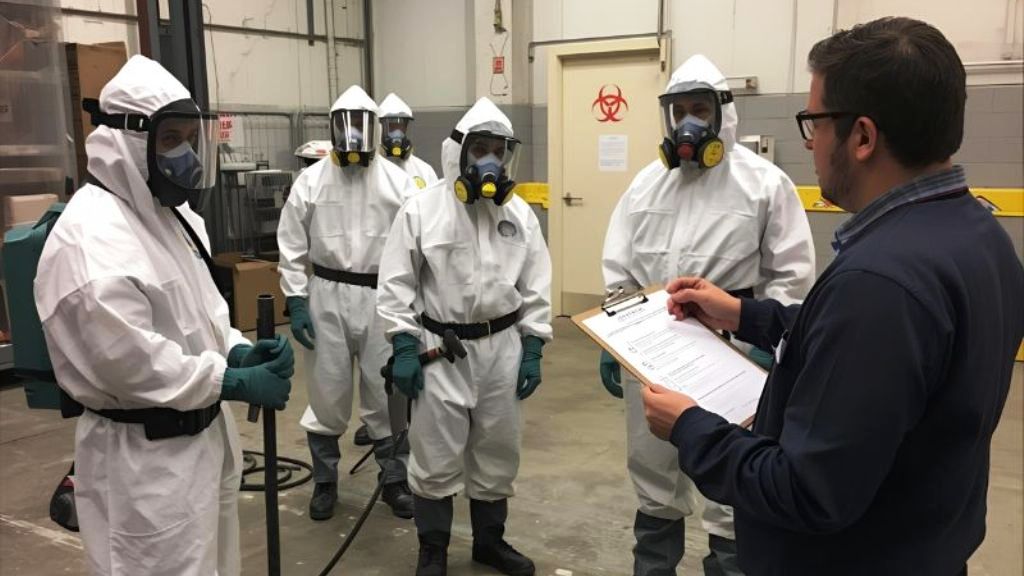
PPE compliance is one of the easiest things for a property owner to visually verify in person, even without any technical background. If technicians arrive without sealed suits, without respirators in a heavily contaminated space, or start work without setting up containment barriers first, that’s a direct signal that the trauma cleanup regulations governing the job aren’t being followed — regardless of how professional the company’s website or sales pitch looked beforehand.
DOT 49 CFR 173.197: Tracking the Path of Regulated Medical Waste
Once biohazardous material is removed from your property, it doesn’t just go in a regular dumpster. The Department of Transportation regulates how it’s classified, packaged, and shipped under 49 CFR 173.197, treating regulated medical waste as a Division 6.2 hazardous material that must be packaged in rigid, leak-resistant containers meeting specific performance standards, marked with the appropriate biohazard symbol and UN 3291 designation, and transported by trained personnel.
Why the Waste Manifest Is Your Ultimate Liability Shield
This is where biohazard disposal laws by state really start to diverge. Many states require generators — meaning you, in many cases, or the company acting on your behalf — to ensure waste reaches a properly licensed treatment facility, and to retain shipping and disposal documentation for a minimum number of years. The regulated medical waste disposal manifest tracking process is what actually proves the material was disposed of legally; without it, you have no documentation if a regulatory question ever arises about where the contaminated material from your property actually ended up.
Ask any company you’re considering for proof of their relationship with a licensed medical waste transporter, and ask specifically for the name and EPA identification number of the incinerator or autoclave facility receiving the waste — not just a vague assurance that it’s “handled properly.” A company that throws cut-out biohazard material into a standard municipal dumpster exposes the property owner, not just the contractor, to environmental illegal-dumping fines in many jurisdictions.
State-by-State Biohazard Disposal Laws: High-Rigor vs. Deregulated Zones
This is the area where trauma cleanup regulations vary the most, and where property owners get caught off guard most often. States generally fall into three tiers of regulatory rigor.
| High-Rigor States (Dedicated Trauma Licenses) | Medium-Rigor States (Folded Into Biomedical Codes) | Low-Rigor States (Rely on Federal OSHA/DOT Alone) |
|---|---|---|
| California — Strict CDPH trauma scene practitioner registration required | Florida — Governed under DOH Biomedical Waste Chapter 64E-16 | Texas — No dedicated state trauma registry; relies on OSHA 1910.1030 |
| Maryland — Requires specialized environmental/remediation business permits | New York — Strictly tracked via DEC Regulated Medical Waste manifests | Georgia — Relies primarily on local solid waste guidelines and OSHA |
| Minnesota — Enforces explicit state health department disposal parameters | Illinois — Regulated via Illinois EPA’s Potentially Infectious Medical Waste (PIMW) tracking | Arizona — No independent trauma practitioner licensing board |
California’s Trauma Scene Waste Management Act Demystified
California’s framework is worth naming specifically because it’s the strictest in the country and the one most property owners misunderstand. Chapter 9.5 of the California Health and Safety Code, beginning at Section 118321, established the Trauma Scene Waste Management Act, which requires anyone undertaking the commercial removal of human blood, body fluids, or related residue from a trauma scene to register as a trauma scene waste management practitioner with the California Department of Public Health.
Operating commercially in this space without that registration is not just a licensing technicality — it’s treated as a violation of the Medical Waste Management Act, and practitioners must also maintain a documented contractual relationship with a registered transporter or permitted medical waste facility. Trying to save money by hiring an unregistered “handyman” cleanup operator in California isn’t a gray area; it’s hiring someone operating outside the law, and that exposure can land back on you as the property owner if anything goes wrong.
The Florida and Texas Structural Loophole Nobody Mentions
Florida and Texas are frequently described as “unregulated” for crime scene cleanup, and in the narrow sense of trauma-specific licensing, that’s accurate — neither state requires a dedicated trauma practitioner license the way California does. But that doesn’t mean the work is lawless, and treating the absence of dedicated crime scene cleanup regulations as a free pass is exactly how property owners end up in trouble.
Florida’s biomedical waste rules, found in Chapter 64E-16 of the Florida Administrative Code, define biomedical waste to include absorbent material saturated with blood or blood products — which means the moment a contractor cuts blood-contaminated subflooring, carpet padding, or drywall out of your home, that material legally becomes regulated biomedical waste requiring a permitted transporter and proper manifest tracking, regardless of the fact that the crime scene cleanup itself isn’t separately licensed. The same structural logic applies in Texas: the cleanup company doesn’t need a special trauma license, but the contaminated materials they remove are still subject to state biomedical and hazardous waste handling rules.
Maryland and New York’s Licensure Hardlines
On the strict end, Maryland requires companies performing this kind of remediation to hold a specialized environmental or remediation business permit before operating commercially. New York takes a different but equally rigorous approach: the state’s Department of Environmental Conservation imposes intensive tracking on regulated medical waste, assigning unique generator identification numbers to locations processing higher volumes of biohazard removal, which creates a documented paper trail tied specifically to the property and the job.
If your state doesn’t have detailed crime scene cleanup regulations on the books, that doesn’t mean anything goes — OSHA and DOT requirements still apply in full, and your state’s general environmental and waste disposal statutes still govern how contaminated material can be handled. Calling your state’s environmental or public health department directly is a five-minute step that tells you exactly which tier your property falls into.
Real Estate Disclosure Laws: When Are You Legally Forced to Disclose a Death?
This is one of the most misunderstood corners of biohazard cleanup laws, particularly for anyone planning to sell or rent the property afterward.
There is no federal law requiring unattended death real estate disclosure by state to follow a single standard, and most states don’t require disclosure at all. A relatively small number of states have specific statutes addressing what’s known in real estate as a “stigmatized property” — meaning a property psychologically impacted by an event like a death, suicide, homicide, or felony crime that has no physical effect on the structure itself.
The 3-Year Rule: Navigating Stigmatized Property Statutes
California requires sellers to disclose any death that occurred on a property within the past three years, regardless of cause — a window worth marking on your calendar the moment an incident occurs, since any transfer of ownership within that 36-month period triggers a proactive, written disclosure obligation to prospective buyers.
South Dakota and a handful of other states require disclosure of a death within the past twelve months, generally limited to homicide, suicide, or felony-related deaths. Many other states, including Texas and Florida, impose no disclosure obligation at all unless a buyer directly asks — at which point misrepresenting the answer can create legal liability even where no proactive disclosure duty exists.
This patchwork means your obligations depend entirely on where the property is located, and it’s worth confirming directly with a local real estate attorney before listing a property with this kind of history, since the rules can also vary based on whether the death was natural, violent, or by suicide.
The Financial Reality: Homeowners Insurance Caps and Decontamination Costs
Separate from the legal disclosure question is a financial reality most property owners don’t discover until they’re already filing a claim. Standard homeowners insurance coverage for crime scene cleanup typically falls under “sudden and accidental” damage clauses in HO-3 and HO-5 policies, which generally do cover biohazard remediation triggered by a covered event like a violent crime or unattended death.
What catches people off guard is that insurers are increasingly enforcing specific dollar caps — often somewhere in the $5,000 to $10,000 range — on biohazard or pollutant cleanup coverage, buried in policy language that’s easy to miss when a policy is purchased years before any incident occurs. A remediation job that runs $15,000 or $20,000, which isn’t unusual for a property with extensive contamination, can leave you covering a substantial gap out of pocket if you didn’t know the cap existed.
Before any work begins, request an unredacted copy of your policy’s property damage exemptions and limitations page directly from your insurer, not just a verbal summary from an agent, so you know your actual exposure before signing off on a scope of work.
The Property Owner’s Biohazard Compliance & Liability Checklist
Before allowing anyone to touch a contaminated scene, confirm that these basic biohazard remediation legal requirements are met:
[ ] Secure the formal jurisdictional release. Ensure police, the coroner, or the medical examiner have officially signed off and released the scene. Starting cleanup early can create legal complications, including allegations of interfering with an active investigation.
[ ] Demand OSHA bloodborne pathogen training records. Don’t accept a verbal “we’re certified.” Ask the on-site supervisor for physical or digital copies of technicians’ OSHA 29 CFR 1910.1030 compliance documentation.
[ ] Verify the cradle-to-grave waste manifest destination. Ask for the name and facility ID of the medical waste incinerator or autoclave receiving the waste. If a company can’t produce this, you may be exposed to environmental fines tied to your own property.
[ ] Run a 3-year disclosure audit if applicable. If your property is in a high-disclosure state like California, mark the incident date. Any sale within that window requires proactive written disclosure.
Property-Owner Responsibilities: What You’re Actually on the Hook For
Strip away the layers of federal and state regulation, and the biohazard remediation legal requirements that actually fall on a property owner come down to a few concrete things: not allowing cleanup before the scene is officially released, hiring a company that’s verifiably compliant rather than one that just looks the part, retaining the waste manifest and completion certificate indefinitely, and understanding which regulatory tier your specific state falls into rather than assuming “someone else handles this.”
BioRecoveryPro works with certified remediation professionals who operate in full compliance with OSHA, DOT, and applicable state requirements, and who can walk property owners through exactly what documentation — including trauma scene waste management act compliance paperwork where applicable — to expect at each stage.
Final Thoughts
Biohazard cleanup laws were never designed to be intuitive to the average property owner, and that gap is exactly why so many people end up either overpaying for unnecessary work or, worse, hiring a company that quietly fails to meet the legal standard their property actually requires. Understanding the basic structure — OSHA for worker safety, DOT for waste transport, and biohazard disposal laws by state that vary from California’s strict licensure regime to Texas and Georgia’s lighter-touch frameworks — gives you enough of a foundation to ask the right questions before you sign anything.
If you’re facing this situation right now, the fastest path to clarity is a direct call to your state’s environmental or public health department, followed by a conversation with a certified remediation company about exactly which statutes apply to your property, and a hard look at your insurance policy’s cleanup coverage cap before work begins. The regulations exist to protect you as much as anyone else — but only if you know enough to ask for proof that they’re actually being followed.

Pingback: Do You Legally Have to Tell Buyers Someone Died in Your House? - BioRecoveryPro
Pingback: From One-Off Jobs to Six-Figure Contracts: How Biohazard Companies Break Into Municipal and Corporate Work - BioRecoveryPro
Pingback: The Waste Manifest Mistake That Ends Biohazard Businesses Before They Start - BioRecoveryPro
Pingback: Biohazard Waste Manifests: Why Your Liability Doesn't End When the Cleanup Crew Leaves - BioRecoveryPro