

Most people never think about whether their homeowners insurance covers bio-recovery cleanup — until they’re standing in front of a crime scene, a decomposition situation, or a traumatic incident at their property and someone hands them a quote for thousands of dollars. The good news is that homeowners insurance coverage for biohazard remediation is more common than most people expect. The bad news is that the details vary significantly between policies, and how you handle the first few hours can make or break your claim.
Does Homeowners Insurance Cover Biohazard Cleanup? (2026 Claim Guide)
The short answer: yes, in most cases — with conditions.
Most standard homeowners’ insurance policies (HO-3 and HO-5) include coverage for crime scenes, accidents, and traumatic events when the damage results from a sudden, unexpected event. The technical term adjusters use for this is a “covered peril” — a specific trigger event that the policy recognises as the basis for a valid claim. The key operative phrase to memorise before calling your adjuster is “sudden and accidental.”
Insurers routinely deny claims where biological contamination accumulated over a prolonged period, because gradual contamination falls under wear and tear rather than a discrete, insurable event. A single traumatic accident is readily covered; long-term hoarding-related contamination is met with significant friction, and for good reason — the distinction is written directly into most policy language.

The Core Clause: Understanding “Sudden and Accidental” Covered Perils
HO-3 vs. HO-5 Policies: How Criminal Acts Trigger Coverage
Under standard HO-3 and HO-5 homeowners policies, violent crime scenes and homicides trigger coverage through what’s called the “Third-Party Criminal Act” or vandalism clause — a provision that treats damage caused by a third party’s criminal activity as a covered peril, even when the damage involves biological contamination. This is important because some policies have explicit biohazard or “pollutant” exclusions that might otherwise apply; the criminal act clause typically overrides those minor caps, making homicide and assault cleanup one of the most consistently covered categories in the biohazard space, with approval rates above 90% at most major carriers.
Suicide cases are generally covered under accidental or sudden peril clauses as well, though a small number of policies carry explicit exclusions for intentional self-inflicted damage within the first two years of the policy — worth checking your specific declarations page.
Scenario Breakdown: What Each Situation Actually Triggers
When Does Structural Decomposition Transition to Covered Property Damage?
Property owners frequently get blindsided when an insurer covers blood removal from walls but disputes structural tear-outs. Here is why that happens, and how to argue against it: when biological fluids seep through carpeting and penetrate subfloor plywood, the subfloor itself becomes a biohazard that cannot be sanitised by surface cleaning. It must be cut out and replaced. Under most HO-3 and HO-5 policies, structural demolition and replacement is covered under “Property Damage,” not just “Bio-Services” — but the claim has to be framed correctly from the start using proper line-item documentation (more on that below).
| Traumatic Scenario | Standard Coverage (HO-3/HO-5) | Primary Policy Trigger | Common Denial Reason |
|---|---|---|---|
| Homicide / Violent Crime | Fully covered — 90%+ approval | Third-Party Criminal Act / Vandalism clause | No police report, or scene disturbed before release |
| Suicide / Self-Harm | Generally covered | Sudden and accidental peril clause | Explicit policy exclusion within first 2 policy years |
| Unattended Death (Natural) | Covered for structural damage | Sudden, unforeseen decomposition altering structural integrity | Attributed to long-term neglect if body went undiscovered for months |
| Fentanyl / Meth Contamination | Highly restricted / often excluded | Pollutant and chemical contaminant clauses apply | Categorised as illegal manufacturing by a resident |
| Severe Hoarding Hazards | Almost universally denied | Classed as gradual long-term maintenance failure | Denied under “Wear and Tear” or “Lack of Maintenance” |

Hidden Policy Caps: The Deductible and Reimbursable Limit Realities
Why Your Insurer Must Pay for Subfloor Demolition and Structural Extraction
In most cases, you’ll pay your deductible — typically $500 to $2,500 — and insurance covers the rest. On a $10,000 cleanup job, that’s the difference between $500 out of pocket and paying the entire bill yourself. Some standard policies cap biohazard cleanup reimbursement at $10,000 to $25,000. If your remediation costs exceed that cap — which they can in extended decomposition cases — you’re responsible for the difference. Knowing this before you choose a contractor and sign a scope of work is far more useful than discovering it mid-claim.
Inside the Adjuster’s Evaluation: How Xactimate Billing Codes Work
When your claim reaches an adjuster, they aren’t evaluating a vague invoice — they’re reviewing line items against a standardised database called Xactimate, the industry-standard estimating software used by insurance carriers nationwide to price property and remediation claims. Understanding how adjusters evaluate these codes is the single most important practical edge a property owner can have.
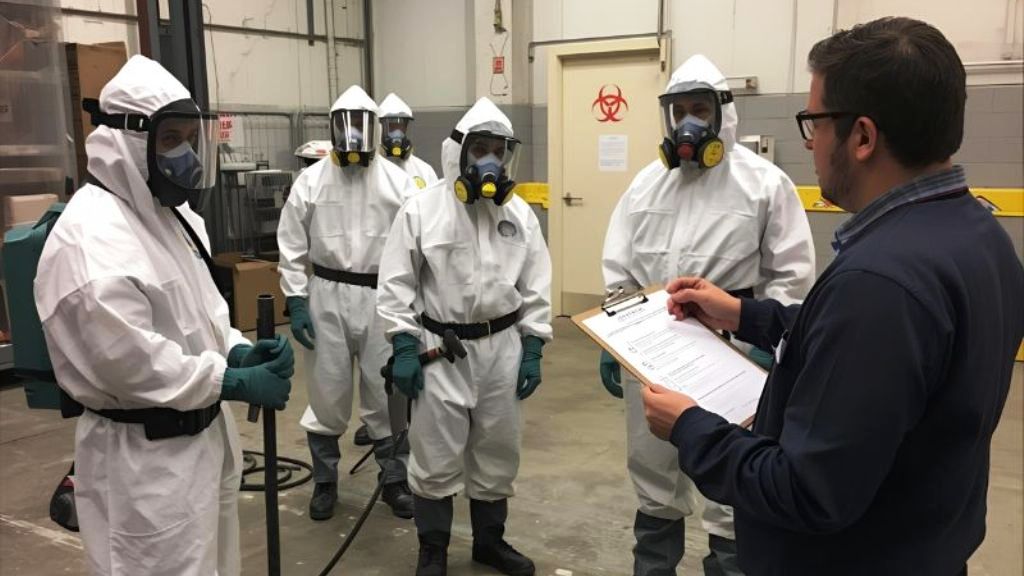
For biohazard remediation specifically, Xactimate contains dedicated line-item codes for every component of a professional cleanup. PPE surcharges are billed under equipment codes that distinguish between general protective gear and the specialised Level C/B equipment — sealed Tyvek suits, full-face respirators, PAPR-filtered hoods, and double-layered nitrile gloves — mandated under OSHA 29 CFR 1910.1030 for bloodborne pathogen exposure environments. An adjuster reviewing a legitimate IICRC-certified biohazard remediation estimate expects to see these coded separately from labour hours, typically at $100 to $250 per technician per day, because they are a legally required operational cost, not padding.
Hazardous waste disposal processing fees are similarly itemised under DOT hazmat codes referencing 49 CFR compliance — covering the per-box packaging costs for DOT-approved bio-boxes, medical waste incineration transport fees, and the chain-of-custody manifest filing required for every regulated medical waste shipment. These typically run $75 to $150 per box and are often the line items adjusters scrutinise most closely, since they require documentation: the waste manifest, the name of the licensed medical waste transporter, and the EPA identification number of the receiving incineration or autoclave facility. A contractor who bills for disposal without being able to provide this documentation chain will have those line items disputed or removed.
The practical implication: always demand an Xactimate billing line-item estimate — not a lump-sum quote. A flat fee of “$8,500 for complete remediation” gives an adjuster nothing to validate and everything to dispute. An itemised Xactimate estimate with discrete codes for PPE, waste disposal, labour hours, structural demo, odour treatment, and ATP verification testing gives the adjuster exactly the format they need to approve the claim efficiently.
The Adjuster Checklist: How to Document a Claim Without Jeopardising It
Why You Have the Absolute Legal Right to Choose Your Own IICRC Contractor
The Critical 4-Step Claim Protection Protocol
[ ] Secure the police report number first. Do not call a cleaning crew until law enforcement issues a formal case or incident number. Your adjuster requires this to open a file for any violent crime or suspicious death.
[ ] Take macro and micro photographs. Photograph room entrances (macro) and specific structural surfaces affected (micro) before any technicians cross the threshold. A certified cleanup company will also document the scene, but your own photos exist independently of their records.
[ ] Demand an itemised IICRC Xactimate estimate. Ensure your contractor uses Xactimate with clear line-item breakdowns — PPE surcharges, hazardous waste disposal codes, air scrubbing cycles, structural demo — rather than a single flat fee. This is the format adjusters require to process claims efficiently.
[ ] Request a Proof of Loss form immediately. Request this document from your adjuster via email within the first few days. Filing it promptly legally locks in your timeline and prevents adjusters from later disputing when the incident was reported.
One more right worth knowing: your insurance provider cannot legally steer you toward a specific remediation company. You have the absolute right to choose your own IICRC-certified biohazard remediation expert. Insurance-referred companies sometimes inflate quotes or delay work. You are entitled to get your own quote from an independent contractor you select, then submit that to your insurer.

How to Overturn a Denied Biohazard Insurance Claim
Claim denials happen — but they are not always final. Request a written explanation for the denial and review your policy language for ambiguous wording. If you believe the claim was wrongly denied, you can formally appeal the decision or engage a public adjuster to negotiate on your behalf. Keep records of every expense: invoices, receipts, communications with your insurer, and all out-of-pocket costs. These records are essential if you escalate.
Leveraging State Crime Victim Compensation Boards for Out-of-Pocket Costs
If your claim is denied, reduced, or leaves a significant deductible gap, and the cleanup was caused by a violent crime, there is a funding option most property owners never discover: every U.S. state, plus D.C. and the territories, operates a Crime Victims Compensation (CVC) program funded in part through the federal Victims of Crime Act. Crime scene cleanup is an explicitly covered eligible expense under these programs — but reimbursement caps vary significantly by state.
New York recently expanded eligibility, with crime scene cleanup reimbursement available regardless of whether the victim lived at the scene, up to $2,500. Illinois’s program covers biohazard remediation, blood cleanup, odour elimination, and structural decontamination as part of an overall cap of up to $45,000 for crimes occurring on or after August 7, 2022. Wisconsin caps crime scene cleanup compensation at $1,000. All CVC programs operate as a payer of last resort — meaning you must exhaust other insurance coverage first — and most require a police report filed within a specified timeframe. Contact your state Attorney General’s office or the National Association of Crime Victims Compensation Boards to confirm your state’s specific benefit and application process.
Additional Coverage Worth Knowing About
If you rent out your property, your standard homeowners policy may not apply. Landlord-specific insurance may provide coverage for cleanup after tenant-related deaths, crime scenes, or hazardous conditions. For contamination caused by floodwater, coverage depends on whether you hold a separate flood insurance policy — standard homeowners policies typically exclude flood damage entirely.
The Bottom Line
Most people in this situation will find that their homeowners insurance covers a significant portion of the cleanup cost — often all of it beyond the deductible. The key is acting quickly, documenting thoroughly, calling your adjuster before work begins, and using an IICRC-certified biohazard remediation contractor who provides Xactimate line-item billing your insurer can process without dispute.
If you need a verified, IICRC-certified specialist in your area who has experience working directly with insurance providers, submit a request and we’ll match you within minutes.

Pingback: Found Your Pet Dead and Decomposed? Here's Exactly What to Do - BioRecoveryPro