
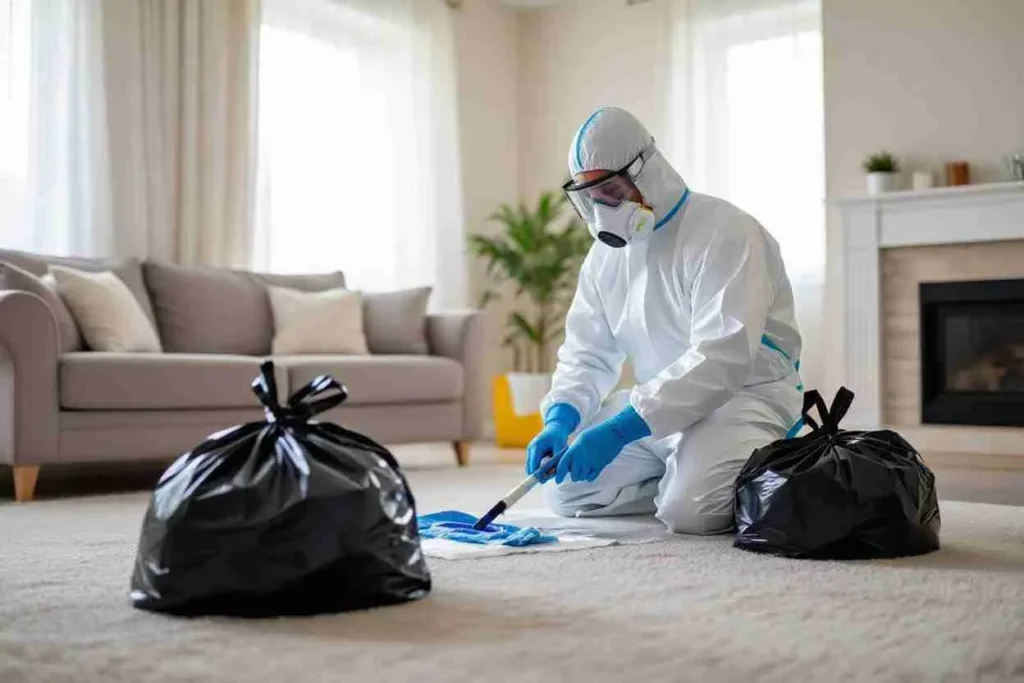
When something traumatic happens on your property — a violent crime, an unattended death, a hoarding situation, or an infectious disease exposure — you’re suddenly forced into a hiring decision you’ve never made before, in one of the worst moments of your life. Police have left. The scene has been released back to you. And now you need to find someone who can handle what’s been left behind.
That’s the exact moment bad actors count on.
The biohazard cleanup industry has no universal federal licensing body and no government agency that vets every company in your search results. What exists is a wide spectrum — from IICRC-certified professionals who work transparently with insurance adjusters and follow legal disposal protocols to completely unqualified operators who know how to look credible online. This guide gives you the questions to ask, the documents to demand, and the red flags to run from before signing anything.
What to Do Before Hiring a Biohazard Cleanup Company: The Response Sequence
Before any remediation company enters the picture, a specific chain of events has to happen in order. Rushing it is expensive.
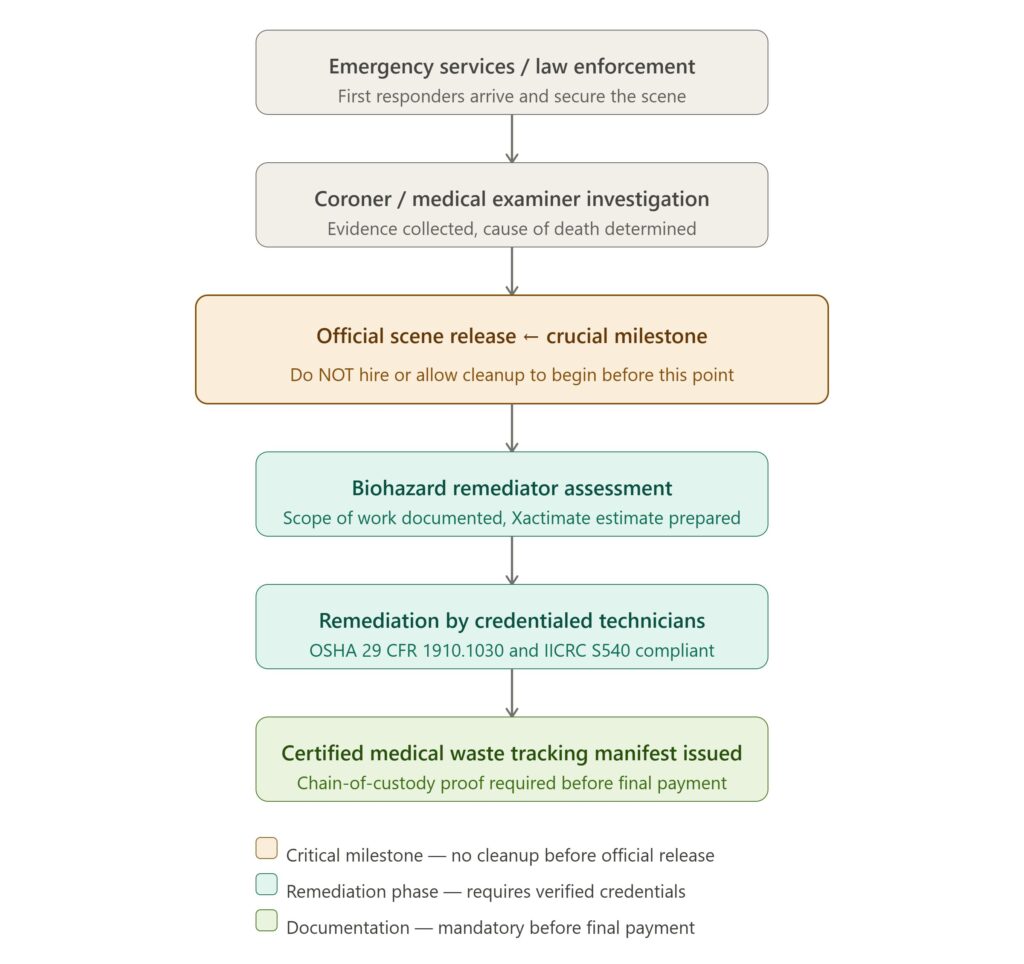
The scene release is the critical milestone most people miss. It means law enforcement is done with the space for investigative purposes — not that it’s safe or clean. Everything after that point, including the hazard and the liability, is yours.
One immediate physical step before anything else: turn off your HVAC system. The instinct when odor is present is to run the air conditioning. This is a serious mistake. Turning on HVAC pulls airborne pathogens, volatile organic compounds (VOCs), and microscopic tissue fibers directly into your ductwork, cross-contaminating the entire structure. A single-room remediation can become a whole-building air scrubbing job costing $10,000 or more. Turn the system off, leave it off, and don’t touch it until a remediation professional has assessed the space.
Vetting Local Remediators vs. Out-of-State Predatory Brokers
This is the most underreported consumer protection problem in the biohazard space, and it catches grieving families constantly.
When you search for a local biohazard cleanup service, a significant portion of results — particularly the ones with polished websites and local phone numbers — are not local companies at all. They’re national marketing brokers who harvest your inquiry, add a 30–50% middleman markup, and subcontract the actual work to unvetted local laborers with no specific biohazard training.
Ask directly: “Are the technicians performing the work W-2 employees of your specific company? And can you provide your local state business license number right now?” A legitimate local operator answers both without hesitation. A broker deflects or provides a corporate headquarters in a state entirely different from yours.
When choosing a crime scene cleanup service, who physically does the work isn’t a detail — it’s the entire thing.

How to Avoid the Assignment of Benefits (AOB) Insurance Trap
Most homeowners and commercial property policies cover biohazard remediation when the contamination results from a covered event. Contact your insurer before cleanup begins to open a claim. But there’s a predatory mechanism specifically targeting the insurance process that you need to know about first.
It’s called an Assignment of Benefits (AOB).
A remediation company asks an overwhelmed homeowner to sign an AOB form, framing it as a convenience — they’ll handle everything with the insurance company directly. What you’ve actually done is signed over your insurance rights entirely. The company can now bill your insurer for any amount without your approval. They inflate the claim. The insurer disputes it. While that dispute is unresolved, the company places a mechanic’s lien on your property.
Never sign an Assignment of Benefits. Instead, look for a company that works directly with adjusters using Xactimate estimating software — the industry-standard pricing tool that ensures claims are priced against established benchmarks, not invented numbers. Ask if they use it. If they don’t know what it is, keep looking.
Essential Compliance Standards: OSHA 29 CFR 1910.1030 and IICRC S540
Understanding what legitimate credentials actually look like is a core part of the questions to ask a cleanup company before you agree to anything.
The OSHA Bloodborne Pathogens Standard (29 CFR 1910.1030) is federal law. It requires that any worker with occupational exposure to blood or other potentially infectious materials complete formal bloodborne pathogen training, undergo a medical evaluation, and maintain Hepatitis B vaccination documentation. Ask to see proof of this training for each technician who will be on your property.
The IICRC S540 Standard for Trauma and Crime Scene Cleanup is the industry’s technical benchmark — it governs how contamination is assessed, how porous materials are evaluated for saturation depth, and what documentation is required at job completion. A lead technician certified under S540 has demonstrated specific knowledge of trauma scene remediation, not just general cleaning work.
A company that can reference both standards by name and produce documentation is operating at the level this situation requires.
The 5-Minute Biohazard Contractor Vetting Checklist
Before allowing any remediation team on your property, verify all four of these:
[ ] OSHA 29 CFR 1910.1030 Compliance — All on-site technicians must have documented Bloodborne Pathogen training and current Hepatitis B vaccination records. Request copies.
[ ] IICRC S540 Certification — The on-site supervisor should hold certification under the IICRC S540 Standard for Trauma and Crime Scene Cleanup — not just general remediation credentials.
[ ] Pollution/Environmental Liability Insurance — Standard general liability insurance does not cover biohazard incidents. The company must carry a specialized pollution or environmental liability policy in addition to GL and workers’ comp.
[ ] Pre-Remediation Photo Documentation Protocol — Before any material is moved, the company should conduct room-by-room photographic documentation. Without this baseline record, your insurance carrier will likely deny or significantly reduce your structural restoration claim.
Biohazard Cleanup Red Flags to Watch For
The trauma cleanup contractor checklist matters because the patterns of fraud in this industry are well-documented. The FTC has flagged disaster and emergency service contexts as prime environments for predatory operators who target people at their most vulnerable.
The pressure close. A company shows up fast, presents a large number, and pushes hard for an immediate signature — often with artificial urgency. Any operator demanding cash upfront or refusing to put their license and insurance in writing before you’ve read the contract is displaying a documented warning sign.
The surface-clean disappearing act. Some operators complete the visible cleanup, collect full payment, and are unreachable afterward. The problem: biohazard contamination is not a surface issue. Blood and decomposition fluid penetrate carpet backing, padding, subfloor, and drywall. Without ATP meter testing to verify biological residue has been eliminated at depth, no job is confirmed complete.
No waste manifest. When the job is complete, you must obtain a Medical Waste Tracking Manifest before final payment. Under the Medical Waste Tracking Act and state equivalents, biohazardous waste cannot legally go into a standard dumpster — it must be transported by a licensed medical waste carrier and treated at a certified facility. The manifest is your chain-of-custody proof. It protects you from environmental liability, and both your insurer and any state crime victims compensation program will request it as part of the claims process.
Other immediate red flags: no verifiable physical address; cash-only pricing; verbal-only quotes with nothing in writing; pressure to sign before reading anything; asking you to sign an AOB.
What a Legitimate Company Looks Like
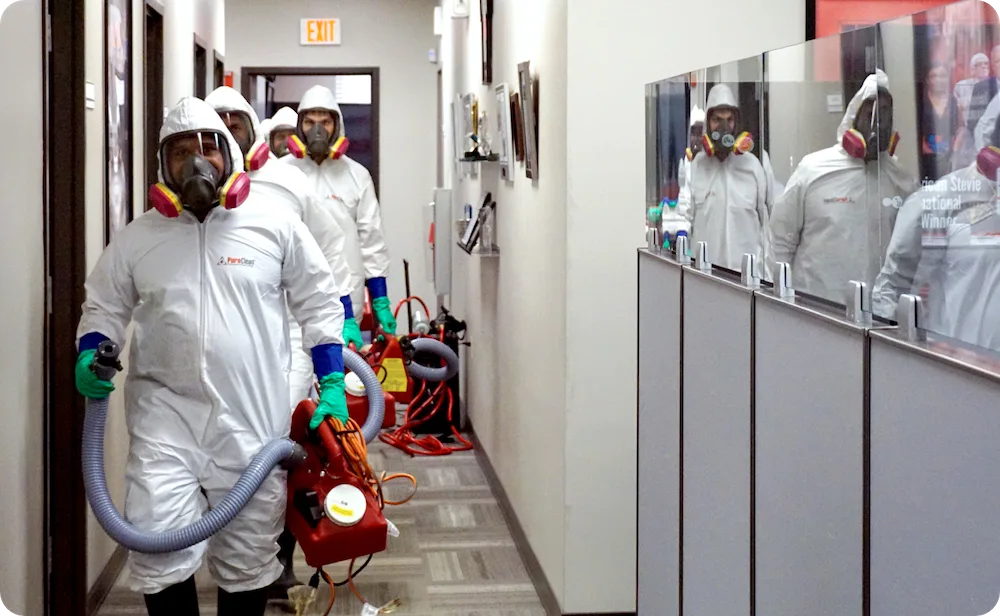
A qualified operator references OSHA 29 CFR 1910.1030 and IICRC S540 by name without being prompted. They produce insurance certificates before you ask twice. They provide a written scope of work and Xactimate-based pricing before touching anything. They document the scene thoroughly before starting. And they deliver a signed Medical Waste Tracking Manifest and a certificate of decontamination when the job is complete.
They don’t pressure you. They work directly with your insurance adjuster. They answer every question before any paperwork changes hands.
BioRecoveryPro connects property owners with IICRC-certified, OSHA-compliant professionals across all 50 states — contractors who are credential-verified before they ever receive a referral and who handle insurance coordination directly. If you need someone qualified without doing the vetting from scratch, that’s where to start.
Final Thoughts
The steps here — verifying credentials, confirming disposal compliance, understanding the AOB trap, isolating the HVAC, and demanding the manifest at completion — take less than an hour to work through. They can protect you from consequences that last for years.
The questions to ask a cleanup company aren’t adversarial. Any legitimate operator expects them. The companies that resist, deflect, or rush you past them are precisely the ones this guide exists to help you identify.
Turn off the HVAC. Don’t sign the AOB. Get the manifest. And don’t let anyone start work before the scene is officially released.