

In the minutes and hours after something violent happens at your home or business, almost nothing feels clear. Maybe police are still on scene, maybe they’ve just left, maybe you’re standing outside your own property trying to process what just happened while also wondering, practically, what comes next.
Knowing what to do after a violent crime occurs on your property won’t undo what happened — but it will help you move through the days that follow without making costly mistakes, and it will help you recover both your space and your finances faster. This guide walks through the full sequence: the police response, when you can legally re-enter, how to file an insurance claim (including funding sources most people never hear about), what professional decontamination actually involves, and what landlords specifically need to know about their legal obligations.

Phase 1: Navigating the Police Response and Scene Lockdown
If a violent crime has just occurred — an assault, a shooting, a home invasion, anything involving injury or death — your first responsibility is confirming emergency services have been contacted. If they haven’t, call 911 immediately. Everything else waits until medical responders and law enforcement have done their work.
Once officers arrive, your property effectively becomes their property for a period of time. They’ll establish a perimeter, often with tape or barriers, to preserve the scene exactly as it was so investigators can do their job properly. This is one of the hardest parts for property owners to accept in the moment: even if it’s your home or your business, you don’t get to walk back in yet.
When Can You Legally Re-Enter a Crime Scene Property?
A crime scene remains under law enforcement control until investigators have collected and documented everything they believe they need — physical evidence, photographs, forensic samples, witness statements. For straightforward incidents, this might take a few hours. For anything involving serious injury or a homicide, it can take considerably longer, because the scope of documentation is far greater and additional specialists may need to process the scene.
The decision to release the scene typically comes from the lead investigator or forensic team supervisor, once they’ve confirmed nothing further is needed from the physical location. There’s rarely a dramatic announcement — often it’s a simple notification that you’re cleared to re-enter, sometimes with instructions about anything that shouldn’t be disturbed if follow-up evidence collection might still be needed.
Here’s the part that catches people off guard: scene release is not the same as “safe” or “clean.” It means law enforcement is finished with the space for investigative purposes — not that any biohazard contamination has been addressed. The scene is handed back to you in whatever condition the incident left it in, and from that moment forward, the cleanup responsibility is entirely yours.
📑 The Emergency Property Documentation Log
Before anything else happens, open a notes app on your phone and start logging the following. This single habit can be the difference between a smooth insurance claim and a denied one.
- The police report case number — get the exact alphanumeric sequence from the responding officer, along with the precinct name and the lead detective’s contact information
- The property release timestamp — record the exact date and time the crime scene release form is issued and physical control is handed back to you
- A complete pre-cleanup video walkthrough — before anyone touches the space, record continuous video from multiple angles capturing damaged doors, stained flooring, broken windows, and anything else affected, so you have raw documentation before any cleanup begins
- Remediation waste manifests — once a biohazard team begins work, make sure they provide documented waste disposal manifests confirming biological material was disposed of legally and in accordance with state guidelines
Keep this log together in one place. Every item on it will be referenced again in the next section.

Phase 2: Filing the Insurance Claim for Biohazard Damage
This is the phase where the documentation habits above start paying off — and where most of the financial outcome of this entire situation gets decided.
Call Your Insurer Before Cleanup Begins
The single most important early step is contacting your insurance company before any cleanup starts, in order to obtain a claim number. Homeowners insurance coverage for trauma scene cleanup generally applies under standard HO-3 policies when contamination results from a covered event — and violent crime, assault, and break-ins typically fall into that category. Coverage specifics vary by policy, but this is exactly the kind of sudden, unexpected loss homeowner’s insurance exists to address.
What Insurers Typically Require
To process a claim for biohazard cleanup tied to a violent incident, insurers generally ask for the police report, before-and-after photos and video, an itemized scope of work and invoice from a licensed remediation company, and the waste disposal manifests mentioned above. Claims submitted with this documentation complete tend to move significantly faster — reviews of biohazard claims show the large majority result in the insurer covering 80 to 95 percent of remediation costs when documentation is thorough and coverage applies.
How the Crime Victims Compensation Program Can Cover Your Deductible
This is the part most property owners never hear about until it’s too late: every U.S. state runs a Crime Victims Compensation program, typically administered through the state Attorney General’s office or a dedicated office of victim services. These programs exist specifically to reduce the financial burden on victims of violent crime — and in many states, that includes state victim compensation property damage coverage for biohazard cleanup, blood remediation, and structural decontamination costs, often even covering your insurance deductible.
Eligibility and reimbursement caps vary considerably by state. Illinois, for example, can reimburse eligible families up to $45,000 for crime-related expenses including biohazard remediation. North Carolina’s program reimburses a portion of costs after insurance has been billed first, since these programs are generally structured as a “payer of last resort.” Most states require submission of the itemized bill from a certified biohazard cleanup company alongside proof that homeowner’s or renter’s insurance either doesn’t apply or has been exhausted.
The National Association of Crime Victims Compensation Boards maintains contact information for every state’s program — it’s worth checking this regardless of how strong your insurance coverage is, since these funds are specifically earmarked for situations exactly like this one and frequently go unclaimed simply because people don’t know to ask.
Phase 3: Professional Decontamination vs. Dangerous DIY Cleanup
Once the scene has been released and your insurance and victim compensation paperwork is in motion, the decontamination process is where this shifts from a logistics problem to a technical, regulated one.
Understanding OSHA Bloodborne Pathogen and IICRC S540 Compliance
This part matters more than most people realize, and it’s worth stating plainly: under the OSHA Bloodborne Pathogens Standard (29 CFR 1910.1030), standard cleaning crews, maintenance staff, or general handyman services are legally prohibited from cleaning up significant quantities of blood or other biological material unless they’ve undergone specific OSHA training, medical evaluations, and have access to appropriate personal protective equipment. This isn’t a suggestion — it’s federal regulation, and it exists because bloodborne pathogens including HIV, hepatitis B, and hepatitis C can remain active in contaminated material long after it’s no longer visible.
On top of the federal standard, professional trauma scene practitioners adhere to the IICRC S540 Standard for Trauma and Crime Scene Biological Cleanup, developed by the Institute of Inspection, Cleaning and Restoration Certification. This standard governs everything from how porosity and contamination volume are assessed to how long a job should reasonably take given how much time has elapsed since the incident. A remediation company that can speak fluently about both of these standards — and document their compliance — is operating at the level this situation actually requires.
The Professional Process, Step by Step
Blood and bodily fluids seep into porous materials — wood, carpet, grout, concrete — creating hidden reservoirs of biological material invisible once a surface appears wiped down. A proper cleanup begins with technicians assessing the scene using tools like ATP meters, which detect biological residue the naked eye can’t see, to map contamination beyond what’s visually obvious.
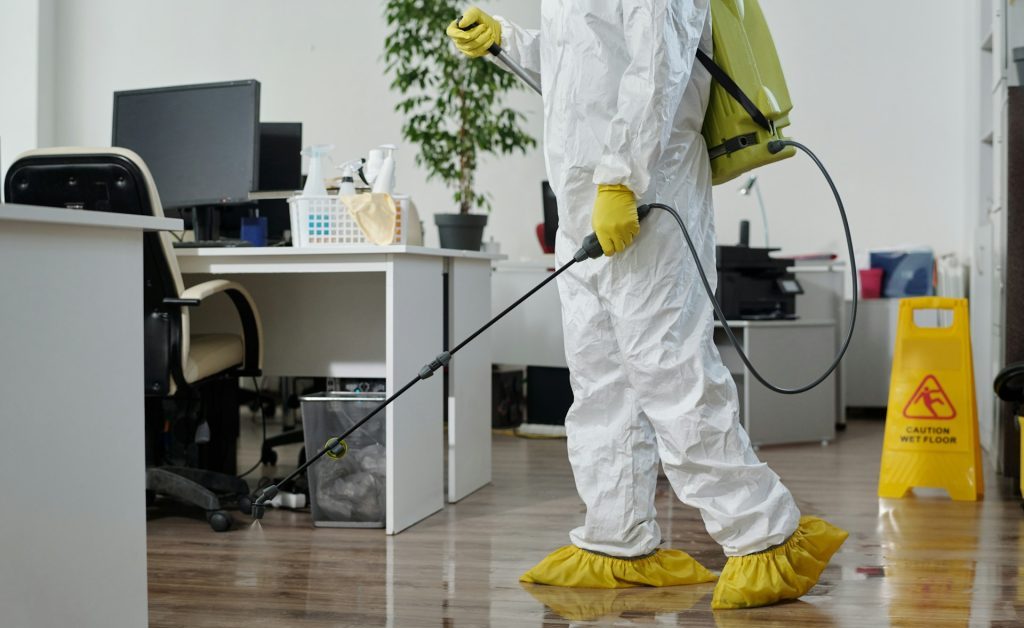
Materials that can’t be fully decontaminated — sections of carpet, padding, certain flooring, drywall that’s absorbed fluid — are removed and disposed of as biohazardous waste through the documented chain of custody that your insurer and victim compensation program will both want to see. Remaining surfaces are treated with industrial-grade, EPA-registered disinfectants designed for bloodborne pathogen decontamination, with technicians working in full protective equipment throughout to prevent cross-contamination into unaffected areas.
Bio Recovery Pro follows both OSHA and IICRC S540 protocols on every job, working directly with your insurance company and providing the documentation — including a certificate of trauma scene decontamination — that both your claim and your victim compensation application will require.
Landlord Responsibilities: Disclosure Laws and Tenant Relocation Rules
If the property involved is a rental — whether you’re the landlord or the tenant — there’s an additional layer of legal obligation that property owners frequently don’t realize applies until it’s already an issue.
Tenant Relocation Obligations
Landlords have a baseline legal obligation to provide a safe, habitable environment. If a violent incident renders a unit unsafe or unusable — whether due to biohazard contamination, structural damage, or both — the landlord may be legally required to cover temporary relocation costs, such as a hotel stay, for the duration of professional decontamination and any necessary restoration. This obligation typically exists independently of whether the landlord’s insurance ultimately covers the underlying cleanup costs, so it’s worth understanding upfront rather than discovering it through a tenant dispute.
Property Stigma and Disclosure Laws
Beyond the immediate aftermath, property owners often want to know what this means for the property long-term — particularly if they plan to sell or re-rent it. Many states have real estate disclosure laws requiring that a violent crime or death on a property be disclosed to future buyers or tenants within a certain window, often three years. California, for instance, addresses this directly under California Civil Code Section 1710.2.
This is where documentation becomes more than an insurance formality — it becomes a long-term legal asset. A certified certificate of trauma scene decontamination from a reputable remediation company serves as your strongest protection against future “property stigma” disputes, demonstrating that the property was returned to a safe, fully decontaminated condition by qualified professionals, regardless of what happened there previously.
Emotional Considerations: What’s Reasonable to Feel Right Now
Amid all of this logistics, it’s worth pausing on something easy to push aside: experiencing a violent crime on your own property — your home, or your business — is a significant event, even if you weren’t physically harmed. It’s common to feel a strange disconnect from the space afterward, even once it’s cleaned, restored, and legally squared away. Some people find they can’t sleep in the same room for a while. Others avoid the property entirely for a period of time.
None of that is an overreaction — it’s a normal response to an abnormal event, and it often doesn’t fully register until the logistics are handled and there’s finally space to feel what happened. Many of the same state victim compensation programs that help cover cleanup costs also fund trauma counseling for victims and property owners, so it’s worth asking about this when you make that call. Addressing it isn’t separate from “getting back to normal” — for most people, it’s part of it.
Final Thoughts
There’s no version of this situation that feels manageable in the moment, but the sequence is more straightforward than it feels when you’re in it. Let law enforcement do their work and don’t rush re-entry. Start your documentation log the moment you’re able to. Call your insurer before anything else happens, and ask about your state’s crime victims compensation program — it exists for exactly this situation and most people never use it. Bring in certified professionals who can speak to OSHA and IICRC S540 compliance for decontamination rather than attempting it yourself. If you’re a landlord, understand your relocation and disclosure obligations before a tenant has to remind you of them. And give yourself, and anyone else affected, permission to feel whatever you’re feeling about it.
Following these steps in order is what gets you from “this happened in my home” to “this is my home again” — safely, completely, with your finances intact, and without the problem resurfacing months down the line.