Most new biohazard cleanup operators make the same mistake. They look at what a competitor charges per hour, apply a similar number, and assume that’s a pricing strategy. It isn’t. It’s a guess — and in this industry, guessing low doesn’t just squeeze your margins, it can make the entire operation unsustainable within eighteen months.
The companies still growing at scale didn’t get there because they were the cheapest. They got there because they understood their actual cost structure, built their biohazard cleanup pricing around it, and built their insurance billing workflows around that. This guide breaks down exactly how that works in 2026 — from hourly versus flat-rate decisions to disposal cost calculations to the Xactimate line items that get claims approved without friction.
Per-Hour vs. Flat-Rate: Which Model Actually Works?
Neither model is inherently superior — the right choice depends on the job type, not a blanket policy.
Hourly billing works for jobs where the scope is genuinely uncertain at the point of estimate. A suspected unattended death where decomposition duration is unknown, or a hoarding situation where biohazard penetration into structural materials can’t be fully assessed until packing begins — these are jobs where hourly billing protects you from absorbing the cost of discovery. Standard trauma cleanup rates in 2026 run $400 to $600 per hour for a two-person crew, with higher rates justified in markets with elevated disposal costs or limited licensed transporter access.
Flat-rate pricing works for well-defined jobs where scope is clear before you start: a single-room blood spill with no structural penetration, a vehicle decontamination, an infectious disease disinfection of a known square footage. These processes through insurance more smoothly and remove the “why did this take so long” friction that hourly billing sometimes generates. Even so, every flat biohazard cleaning estimate still needs to be built from a cost-per-hour foundation — you’re packaging it differently for the client, not discounting the underlying math.
The worst outcome is pricing by gut feel. If your crew spends four hours on a job that costs you $1,100 in labor, disposal, PPE, and overhead, and you quoted $800 because it “seemed about right,” you lost money — and that loss doesn’t show up immediately. It shows up six months later when you can’t figure out why the business isn’t covering its own operating costs.
PPE and Disposal: The Two Cost Lines Most Operators Underestimate
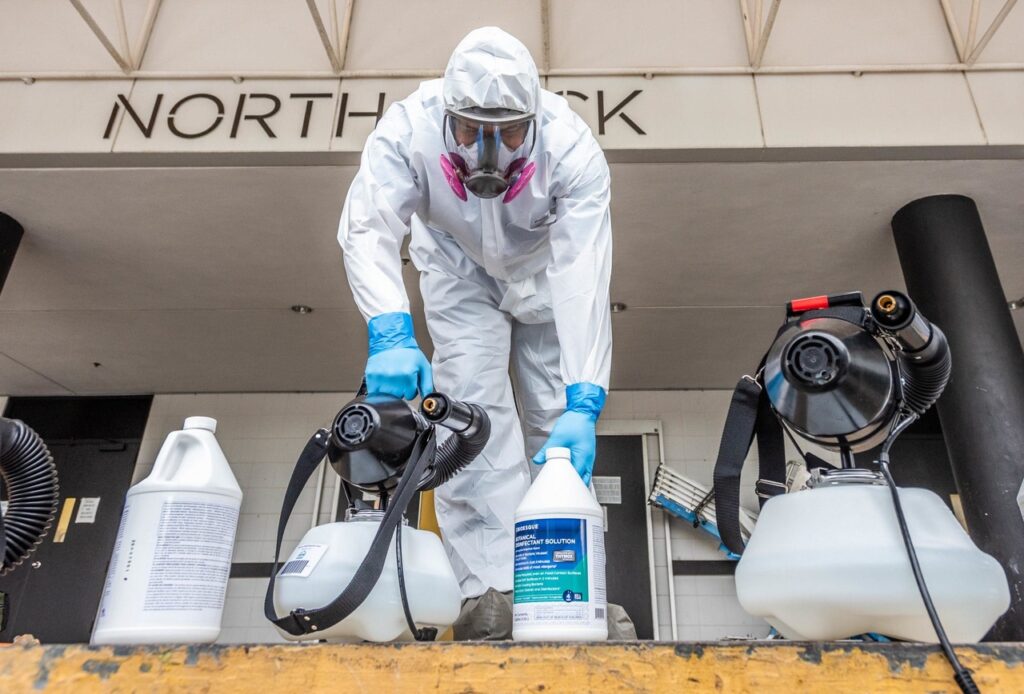
PPE costs per technician per job break down as follows: a Level C or B Tyvek suit runs $8 to $20 per use. Double nitrile gloves, booties, and tape add $5 to $10. For scenes requiring a PAPR unit, add $15 to $40 per technician per day for consumable components. A two-person crew on a two-day decomposition job can accumulate $150 to $250 in PPE costs — costs mandated under OSHA 29 CFR 1910.1030 that must appear as a discrete Xactimate line item, not absorbed into labor.
Biohazard disposal costs are where the math gets ugly fast. Regulated medical waste must be packed into DOT-approved red-bagged bio-boxes, transported by a licensed carrier, and treated at a certified incineration or autoclave facility. Box fees run $75 to $150 per container, depending on your region and contracted volume. A moderate decomposition cleanup might generate eight to twelve boxes — $600 to $1,800 in pass-through costs on a single job. These must never be bundled into a flat cleanup fee. They need their own line item, cross-referenced against the signed waste manifest.
State-level regulations add another layer to disposal pricing that operators often miss. California’s Trauma Scene Waste Management Act (Health & Safety Code Chapter 9.5) requires a specific CDPH practitioner license and a contracted relationship with a registered transporter — licensing and compliance overhead that affects your cost structure before a single job runs. Florida’s biomedical waste rules under Chapter 64E-16 impose manifest requirements the moment contaminated structural material is cut out. New York’s DEC assigns generator tracking numbers to high-volume remediation jobs. Your biohazard cleanup pricing model has to account for the regulatory overhead in your specific operating state — it’s not a rounding error.
Xactimate Line-Item Codes: The Language Adjusters Expect
Mentioning Xactimate in an estimate isn’t enough. Adjusters at major carriers are trained to look for specific category codes, and vague narrative descriptions slow claims and invite disputes. The two primary category groups for biohazard work are HMR (Hazardous Material Remediation) and CLN (Cleaning).
Within HMR, key codes include HMR BIO for general biological hazard remediation labor and containment, and HMR PPE for the personal protective equipment surcharge billed per technician per day. Structural extraction of contaminated materials — carpet, drywall, subfloor — is typically coded under separate demo categories but should reference the HMR scope in the line-item notes to establish the connection for the adjuster reviewing the file.
CLN codes cover surface disinfection passes, HEPA vacuuming, and antimicrobial treatment of non-porous surfaces. Odor remediation — hydroxyl generator deployment, ozone treatment, thermal fogging — is often coded under equipment deployment categories with daily rates and should never be folded into a CLN line item, since adjusters evaluate them differently.
Getting these codes right isn’t a bureaucratic formality. It’s what separates a clean, 72-hour claim approval from a 30-day audit cycle and a reduced payout.
Odor Remediation: Price It as a Separate Service
Decomposition cleanup cost estimates consistently undervalue odor remediation by treating it as part of the cleaning phase rather than a distinct technical service. That misrepresents the scope to the adjuster and leaves money on the table.
A sample odor remediation line-item breakdown for a moderate decomposition case:
- Hydroxyl generator deployment (2 units × 3 days): $900
- HEPA air scrubber operation (1 unit × 3 days): $360
- Thermal fogging of HVAC ductwork: $275
- Odor neutralization agent application: $150
- Odor remediation subtotal: $1,685
This section should appear separately on the estimate — not in a general “cleaning and sanitation” category. It gives the adjuster a defensible breakdown and protects you when clients question the final invoice.
Vehicle and Equipment Overhead: Build It In
Daily Equipment Cost=5-year lifespan$80,000 fleet investment÷annual working days
If your operation runs two vans with a combined monthly cost of $4,000 and completes roughly 20 job-days per month, your per-job vehicle overhead is $200. Equipment depreciation on $80,000 in gear over five years adds roughly $65 per working day. That’s $265 per job in overhead that has to come from your biohazard cleaning estimate — not from hoped-for efficiency gains.
Companies that don’t track this aren’t profitable. They just don’t know it yet.
Collecting the Deductible: A Workflow Most Operators Handle Wrong
Always collect the homeowner’s or renter’s deductible — typically $500 to $2,500 — on-site before work begins. Not after insurance pays out. Not on the invoice. Before. Chasing a grieving family for a deductible three weeks after a traumatic event is bad business and genuinely harmful to people in a vulnerable moment. Collecting it upfront, framed accurately as a standard insurance process requirement, is clean and professional.
Frame it to the client exactly like this: “This is what your policy requires you to pay — we handle everything else directly with your adjuster.” Build this collection step into your standard job intake workflow, document it with a signed receipt, and it removes an emotionally loaded accounts receivable problem from your operations entirely. This applies across all job types — from decomposition cleanup cost recovery to hoarding jobs billed through landlord policies.
Why Underpricing Destroys Profit Margins
Low-price operators cut something to get there — and in hoarding cleanup pricing and decomposition work, the options are limited. PPE quality drops, disposal compliance loosens, technician pay falls below retention levels, or timelines compress until quality suffers. Any one of these creates callbacks, regulatory exposure, and permanent reputational damage.
The property owners and estate managers who generate the most sustainable revenue aren’t looking for the cheapest option. They want someone who sounds like they know exactly what they’re doing, carries the right credentials, and can work directly with their insurance company. Crime scene cleanup cost structure matters to them only in the sense that they want a legitimate, defensible invoice — not a lower one.
Price confidently. Document everything. The operators still growing in this industry five years from now built their pricing from the cost up, not from a competitor’s number down.
Pre-Estimate Checklist and Sample Invoice
Before generating any estimate, verify these line items are accounted for:
- [ ] Labor — calculated by crew size and verified hourly rate, not gut-feel
- [ ] Consumables — separate HMR PPE line items for OSHA-compliant Level B/C gear per technician per day
- [ ] Disposal — hard box counts cross-referenced against the waste manifest, with transporter name and EPA facility ID
- [ ] Overhead — vehicle and equipment depreciation applied as a daily rate
- [ ] Odor remediation — listed separately with equipment deployment codes
- [ ] ATP verification — post-remediation swab testing logged by RLU reading per location
Sample estimate: unattended death, moderate decomposition, 3-day job
| Line Item | Detail | Amount |
|---|---|---|
| Labor (HMR BIO) | 2 technicians × 3 days × $55/hr × 8hrs | $2,640 |
| PPE surcharge (HMR PPE) | 2 techs × 3 days @ $85/tech/day | $510 |
| Biohazard disposal | 10 bio-boxes @ $120/box + manifest | $1,200 |
| Structural removal | Carpet, padding, 40 sq ft subfloor | $875 |
| Odor remediation | Hydroxyl × 3 days, HEPA, fogging | $1,685 |
| ATP verification (CLN) | 12 swab locations @ $35 each | $420 |
| Vehicle/equipment overhead | 3 days @ $265/day | $795 |
| Total | $8,125 |
An operator who quoted $4,500 to win this job isn’t running a competitive strategy — they’re running a liquidation. Build your numbers the right way, and the right clients will follow.
If you’re scaling a biohazard remediation operation and want access to a verified network connecting you with property owners and insurance-managed jobs, BioRecoveryPro’s contractor program is worth exploring.