
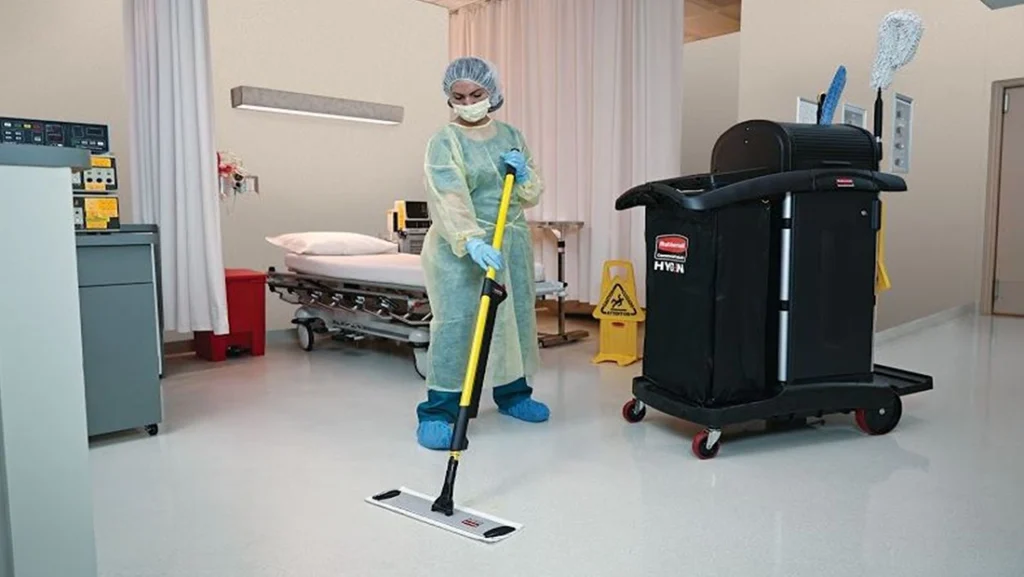
Picture this: a sharps container tips over in a supply closet, or a blood draw goes wrong in a home healthcare setting, and suddenly someone on your team is standing there wondering whether to grab paper towels or call someone. That hesitation — right there — is exactly where most facilities either handle a spill correctly or turn a manageable situation into a compliance nightmare.
Knowing what to do during a medical waste spill isn’t intuitive, and it shouldn’t have to be figured out in real time by whoever happens to be standing nearby. Office managers, clinic supervisors, and group home administrators face this exact scenario more often than most people realize, and the difference between a properly handled incident and an OSHA citation usually comes down to decisions made in the first few minutes. This guide walks through exactly what those decisions should be.
Small Spill or Major Hazard? The Line That Actually Matters
Not every spill requires the same response, and treating a minor incident like a full evacuation — or worse, treating a serious one like a quick wipe-down — both create problems.
Industry protocols modeled on OSHA’s Bloodborne Pathogens Standard generally draw the line around volume and risk level. A spill involving roughly 30 milliliters or less of low-risk biological material, contained to a hard, non-porous surface, can typically be managed by a trained employee using standard PPE and your facility’s documented cleanup procedure. Anything larger, anything involving unknown or higher-risk source material, or any spill that’s touched a porous surface — carpet, ceiling tile, upholstered furniture — moves into territory that calls for a professional response team rather than in-house cleanup.
There’s a third category worth knowing separately: aerosolized release. A dropped vial or a leaking bag produces a spill with a defined edge you can see and contain. A centrifuge malfunction, a broken vacuum line, or any mechanical failure that disperses fine particles into room air is a fundamentally different event, even if it started with the same amount of material. Aerosol incidents call for immediate room evacuation and a waiting period — commonly around 30 minutes — before anyone re-enters, since airborne particles need time to settle before manual cleanup becomes safe at all.
When in doubt, treat it as the larger category. Guessing wrong in the direction of caution costs you a phone call. Guessing wrong the other way costs you an exposure incident.
Infectious Disease Spill Cleanup Steps: What Happens First
Once you’ve sized up the spill, the sequence matters as much as the individual steps.
- Isolate the area immediately. For a larger spill, physically barricade it. For a smaller, contained one, mark it clearly with signage or cones and station someone nearby to keep others from walking through it while you prepare. This isn’t optional — every subsequent step depends on nobody else tracking contamination further while you’re getting ready.
- Do not approach without PPE, ever. This is the step most workplace incidents get wrong, usually out of good intentions. An employee grabs gloves and starts wiping before anyone’s really assessed the situation. Full PPE — gloves at minimum, and depending on spill size, a gown, eye protection, and a mask — needs to go on before anyone gets close, not after they’ve already started.
- Gather the right materials before touching anything. A proper spill kit includes absorbent material for the fluid itself, a biohazard bag or rigid sharps container as appropriate, disinfectant registered for bloodborne pathogens, and a way to seal and label everything for disposal. If your facility doesn’t already have a spill kit stocked and accessible, that’s a compliance gap worth fixing today, not after the next incident.
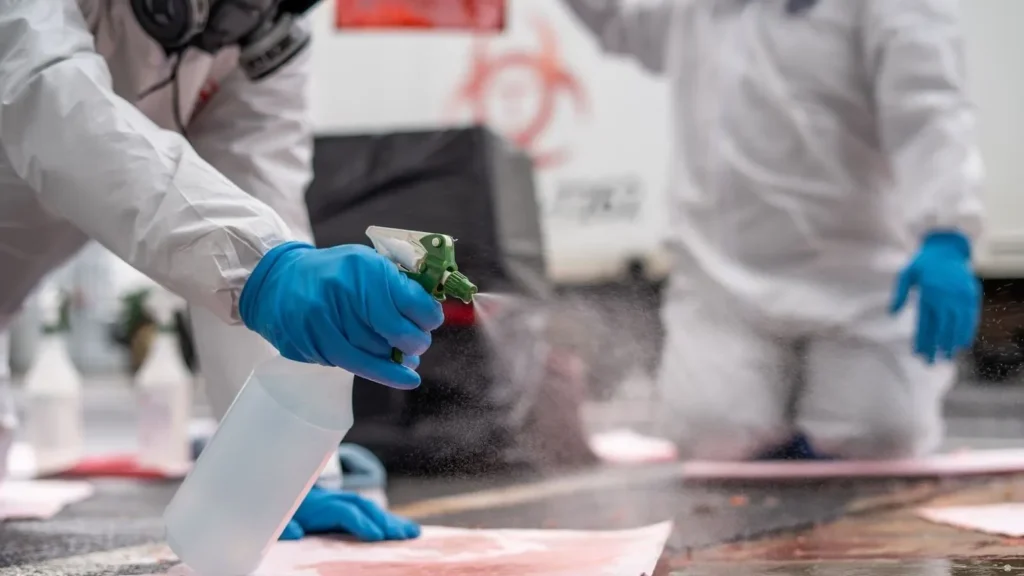
- Contain, then disinfect, in that order. Absorb or remove the bulk material first using disposable materials, then apply an appropriate disinfectant to the affected surface and let it sit for the manufacturer’s specified contact time before wiping again. Skipping the dwell time is one of the most common reasons a “cleaned” spill still leaves viable pathogen behind.
Cleaning Up Bloodborne Pathogen Spills at Work: The PPE Deployment Order
Getting PPE on in the wrong order, or skipping pieces because “it’s a small spill,” is where a lot of workplace exposure incidents actually happen — not during the cleanup itself, but in the improvisation beforehand.
The standard sequence for cleaning up bloodborne pathogen spills at work starts with hand hygiene, followed by a gown or apron if there’s any risk of splashing, then gloves — pulled up over the gown cuffs, not tucked underneath — and finally eye and face protection if aerosolization or splashing is a realistic possibility given the spill type. Double-gloving is common practice for anything beyond a minor, fully contained spill, since it allows the outer glove to be removed and discarded mid-task if it becomes visibly contaminated without breaking the barrier underneath.
After the cleanup is complete, PPE removal follows its own careful sequence specifically designed to avoid self-contamination: gloves come off first, turned inside out as they’re removed; then eye protection; then the gown, rolled inward; and hands are washed thoroughly as the final step, even though gloves were worn the entire time. OSHA’s Bloodborne Pathogens Standard requires this level of procedural discipline precisely because pathogen transfer during removal is one of the most common exposure pathways in occupational settings — more common, in many documented cases, than exposure during the cleanup task itself.
Hazardous Waste Disposal, Accidental Exposure, and the Labeling Rules You Can’t Skip
This is the part of the process that turns into a compliance problem months later if it’s done wrong now, because the paperwork trail is what regulators actually check.
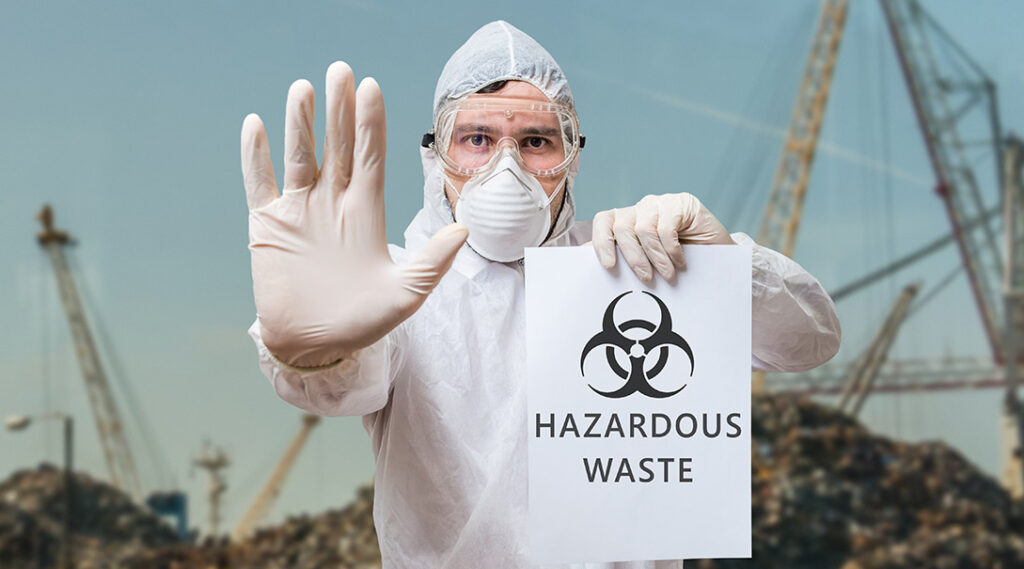
Under OSHA’s regulated waste provisions, any container used to store, transport, or dispose of blood-contaminated material must carry the universal biohazard warning label — the recognizable symbol plus the word “biohazard” — or be color-coded red as an accepted substitute. This applies to the bags used during cleanup, any secondary containment used if the primary bag is compromised, and sharps containers specifically, which must stay upright, get replaced before they overfill, and be sealed closed immediately before removal to prevent spillage during transport.
Hazardous waste disposal accidental exposure situations create a documentation obligation too, separate from the physical cleanup. If an employee is exposed during a spill response — a splash, a needlestick, contact with broken skin — that triggers your facility’s post-exposure evaluation procedure under your Exposure Control Plan: immediate reporting, medical evaluation at no cost to the employee, and a documented record of the incident. Skipping this step because the exposure “seemed minor” is a documented compliance failure waiting to surface at the worst possible time.
One rule trips up more facilities than any other: a single improperly bagged item of contaminated waste placed in a standard trash receptacle doesn’t just create a risk — it can legally convert the entire receptacle into regulated hazardous waste, with disposal and remediation costs that follow accordingly. There is no “small enough to not matter” exception in how this gets enforced.
Hard Surfaces vs. Porous Materials: Why the Cleanup Method Has to Change
A spill on tile, sealed countertop, or stainless steel behaves completely differently from the same spill on carpet or drywall, and treating them identically is how facilities end up with contamination they believe was resolved.
Hard, non-porous surfaces can generally be fully decontaminated in place by a trained employee, provided the right disinfectant and contact time are used, and the surface is genuinely sealed with no cracks, seams, or degraded grout lines where fluid could migrate. This is the category where in-house cleanup, done correctly, is actually sufficient.
Porous materials are a different situation entirely. Carpet, carpet padding, ceiling tile, and any untreated or unsealed drywall absorb biological fluid through capillary action within minutes, carrying contamination below the surface faster than most people realize. Surface-level cleaning on these materials creates the appearance of resolution without actually addressing what’s now embedded in the material itself. In practice, this means porous material affected by anything beyond the smallest, most immediately contained spill typically needs to be removed and disposed of as regulated waste rather than cleaned, since no amount of surface disinfectant reaches contamination that’s already migrated into carpet padding or wallboard.
This is precisely the threshold that separates a spill your team can handle internally from one that needs an emergency medical waste disposal company. If the material involved is porous, if the spill volume exceeds what your facility’s protocol defines as minor, or if there’s any uncertainty about the source material’s risk level, the right call is bringing in a certified team rather than guessing.

When to Call a Professional Response Team
Facilities that get this right have a pre-established relationship with a certified provider before an incident happens, not a scramble to find one afterward. An emergency medical waste disposal company with proper certification brings OSHA-compliant PPE, validated disinfection protocols, and — critically — the documentation trail that protects your facility if the incident is ever questioned later, whether by an inspector, an insurer, or an employee’s own post-exposure claim.
For office managers and clinic supervisors, the practical move is knowing your facility’s threshold in advance: what counts as a minor spill your team handles, what triggers an outside call, and who makes that decision when it happens. Waiting until the moment of the spill to figure out those answers is exactly how a manageable situation turns into a much bigger one.
Final Thoughts
What to do during a medical waste spill comes down to a short list of decisions made correctly and quickly: assess the size and risk category, isolate before anyone touches anything, deploy PPE in the right order, contain and disinfect with proper dwell time, label and dispose of waste according to OSHA’s regulated waste rules, and know without hesitation when a medical waste spill has crossed the line into professional-response territory. The facilities that handle this well aren’t the ones that never have an incident — they’re the ones with a clear, rehearsed process for exactly this moment, so nobody has to improvise when it actually happens.


Pingback: The Waste Manifest Mistake That Ends Biohazard Businesses Before They Start - BioRecoveryPro