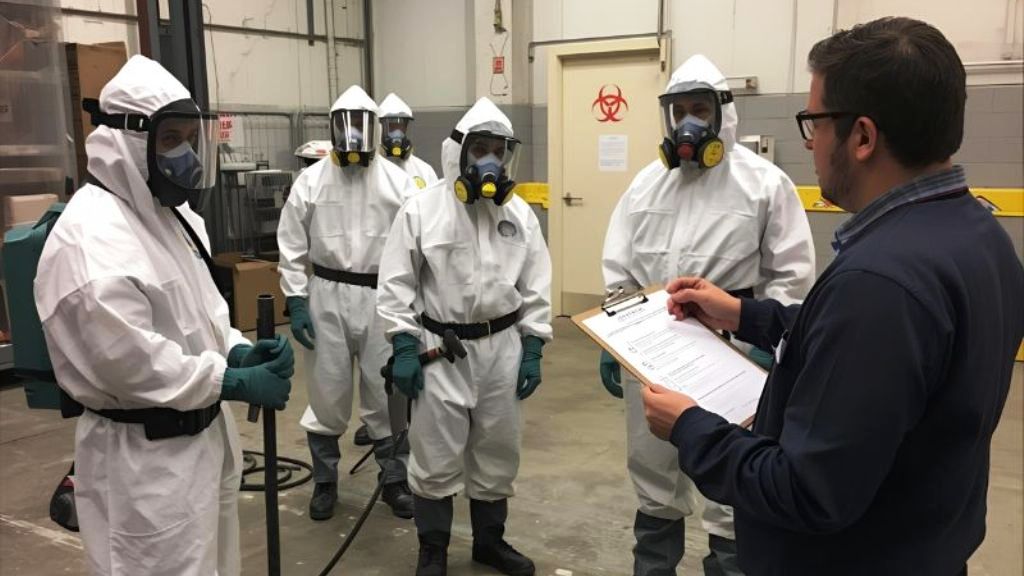

When a violent crime occurs on your property, the people who respond — police, paramedics, the coroner — are there to investigate and preserve life. Not one of them will clean up what gets left behind. That responsibility falls on the property owner or the victim’s family, often within days, and often without any warning that it’s coming.
What most families don’t find out until they’re already staring at a biohazard cleanup bill is that there’s a funding mechanism specifically designed for this situation. Every U.S. state, plus Washington D.C. and most territories, operates a Crime Victim Compensation (CVC) program. These programs exist to reduce the financial burden on innocent victims of violent crime — and crime scene cleanup, biohazard remediation, and structural decontamination are explicitly listed as covered expenses in most of them. The problem isn’t eligibility. The problem is that most families never find out these programs exist in time to use them correctly.
This guide changes that.
What Crime Victim Compensation Programs Actually Are
State CVC programs were created under the framework established by the federal Victims of Crime Act (VOCA), enacted in 1984 and administered through the Department of Justice’s Office for Victims of Crime. The federal government provides a 75% match for every dollar states spend on victim compensation grants to survivors — meaning these programs are substantially federally funded, even though they’re administered at the state level. Understanding state victim compensation eligibility rules before you apply dramatically increases the chance your claim is processed without delay.
Crime victim compensation for biohazard cleanup is one of the most consistently covered expense categories across state programs — alongside medical expenses, mental health counseling, funeral costs, and lost wages. The Illinois Crime Victim Compensation program, administered by the Illinois Attorney General’s Office, can reimburse eligible families up to $45,000 for out-of-pocket expenses directly caused by a violent crime, including biohazard remediation, blood and fluid removal, odor elimination, and structural decontamination.
State programs are always a payer of last resort, meaning you must exhaust or attempt other coverage sources — homeowners insurance, renters insurance, the offender’s insurance, where applicable — before a CVC program will step in for remaining costs. This doesn’t mean you have to wait for an insurance resolution before applying. It means you’ll need documentation showing what insurance covered, what it denied, and what gap remains.
Who Qualifies: The Universal Eligibility Framework
While each state sets its own specific rules, the core eligibility criteria for victim assistance trauma scene funding follow a consistent pattern across programs.
You must be the victim of a violent crime — or a family member of one. CVC programs cover direct victims of qualifying crimes and, in many cases, family members, household members, or other individuals who paid for eligible expenses on the victim’s behalf. The definition of qualifying crimes typically includes homicide, assault, sexual assault, domestic violence, robbery, and similar offenses. Property crimes without personal injury are generally not covered.
The crime must have been reported to law enforcement. This is the single most common eligibility requirement — and the one most frequently missed. In North Carolina, victims must submit a law enforcement report to support the application. Most states require the crime to have been reported within a specific timeframe — often 72 hours to one week. Some states allow extensions for good cause, such as when a victim was physically unable to report, or in domestic violence situations where reporting posed a safety risk.
The victim must not have been engaged in criminal activity at the time of the incident. Most states include a provision that victims who were committing a crime at the time they were harmed are ineligible or subject to reduced benefits. The specific language varies, but the general principle is that compensation is reserved for innocent victims.
You must apply within the statutory timeframe. In North Carolina, victims are generally eligible if they apply no more than two years after the date the crime occurred, with exceptions extending this period in specific circumstances. State deadlines typically range from one to three years. Missing this window permanently bars the claim — there are no extensions for simply not knowing the program existed.
You must cooperate with law enforcement and prosecutors. Most programs require that applicants not obstruct the investigation or prosecution of the crime. Active cooperation is a condition of continued eligibility — and in practice, this means participating in interviews when asked, providing documentation as requested, and not withholding material information from investigators.
What’s Covered — and What the Caps Actually Look Like
The specific coverage categories and dollar limits vary significantly by state. Here’s how the landscape actually breaks down for trauma scene and biohazard remediation costs in 2026:
| State | CVC Program | Cleanup Coverage | Notable Details |
|---|---|---|---|
| Illinois | ICVCP (AG’s Office) | Up to $45,000 total | Explicitly includes biohazard remediation, odor elimination, structural decontamination |
| Texas | CVC Program (AG’s Office) | Covered as eligible expense | Proof that insurance doesn’t apply or is exhausted required |
| North Carolina | Victim Compensation Program (DPS) | 66⅔% of remaining charges after insurance | Provider cannot bill patient for remainder |
| New York | Office of Victim Services | Up to $2,500 for scene cleanup | Expanded 2025 to cover victims regardless of whether they lived at the scene |
| Tennessee | CICP (Claims Commission) | Covered as eligible expense | Includes biohazard cleanup, funeral, medical, and mental health treatment |
For states not listed here, the National Association of Crime Victim Compensation Boards maintains a directory of every state program with direct contact information — the fastest way to find your state’s specific benefit and application process.
The structural reality is that CVC programs almost universally treat crime scene cleanup as a separate expense category from property damage. This distinction matters: most programs will cover biohazard remediation costs related to the biological hazard created by the crime, but structural restoration beyond that — replacing flooring, repainting walls, repairing door frames — may fall under a property damage category that some programs exclude or cap separately. Ask your state program specifically how they categorize remediation that involves structural material removal.

The Payer of Last Resort Rule: How CVC Interacts With Insurance
Emergency biohazard remediation government assistance is designed to fill the gap that insurance leaves — not to replace insurance entirely. This has practical implications for how you sequence your claim.
File your homeowners or renters insurance claim first, even if you’re uncertain whether it’s covered. Document the insurer’s response in writing — whether they approve partial coverage, deny the claim, or request additional information. That written response becomes part of your CVC application documentation.
If insurance covers part of the cost, the CVC program will typically cover eligible remaining expenses up to its own benefit cap, subject to your deductible. If insurance denies the claim entirely, you submit that denial letter as proof of exhaustion and the CVC program evaluates the full cost. If you’re uninsured, document that status explicitly — most programs accept a signed statement confirming no applicable insurance coverage.
What you should not do is wait for the insurance process to fully resolve before contacting your state’s CVC program. These programs have application deadlines measured from the date of the crime, not the date insurance resolves. You can file a CVC application while your insurance claim is still being evaluated — the two processes run in parallel.
Step-by-Step Documentation to Expedite State Fund Disbursement
The speed of your victim assistance trauma scene funding disbursement is almost entirely determined by the completeness of your documentation at the time of application. Incomplete applications are the primary cause of processing delays.
Step 1: Obtain the police report number immediately. Ask responding officers for the incident or case number before they leave the scene. This number anchors your entire application and is required by every state program. If you didn’t get it on-site, contact the responding agency’s non-emergency line the same day.
Step 2: Request the full police report in writing. The incident number gets you started, but the full written report — typically available within 24 to 72 hours — contains the details that support your eligibility. Request multiple certified copies. You’ll need them for the CVC application, for insurance, and for potential legal proceedings.
Step 3: Contact your state CVC program immediately. Don’t wait until the cleanup is complete. Most programs allow you to submit an application before the remediation bill is finalized, with supplemental documentation to follow. Getting the application open early protects your eligibility window and gives you a case number for tracking.
Step 4: Have your remediation company generate a line-itemized invoice. North Carolina’s program requires submission of an itemized bill from a certified biohazard cleanup company. Most programs have similar requirements. A vague invoice that reads “crime scene cleanup — $8,500″ will be scrutinized or rejected. A Xactimate-format line-itemized estimate with discrete codes for labor, PPE, biohazard disposal, structural removal, odor remediation, and ATP verification testing gives the CVC program exactly what they need to process the claim efficiently.
Step 5: Submit documentation of insurance status. Whether you have coverage, partial coverage, or no coverage, document it in writing. Texas’s CVC program requires proof that homeowners’ or renters’ insurance does not apply or has been exhausted, such as the assignment page, homeowner’s policy, or a statement from the claimant.
Step 6: Cooperate actively and follow up. State crime victim compensation eligibility rules require ongoing cooperation with the investigation. Respond promptly to any requests for additional information from the CVC program. Most programs have online portals where you can track application status — use them.

Who Pays for Crime Scene Cleanup for Victims Without Insurance?
For uninsured or underinsured families, state CVC programs represent the primary financial safety net — but they’re not the only one.
Some IICRC-certified remediation companies work with CVC billing directly, submitting their documentation to the state program and invoicing the program rather than the family. Ask any company you’re considering whether they have experience with CVC billing and whether they can assist with the documentation process during the cleanup itself — this significantly reduces the administrative burden on a family in crisis.
For expenses that fall outside CVC coverage categories or exceed program caps, a small number of nonprofit organizations specifically assist crime victim families with trauma-related financial burdens. Local victim advocacy organizations — typically reachable through your county court system or the state AG’s office — can identify resources specific to your community.
BioRecoveryPro connects families with IICRC-certified specialists experienced in CVC documentation and insurance billing workflows, including line-itemized Xactimate estimates prepared specifically for state compensation program requirements — available 24/7 across all 50 states.
Final Thoughts
State crime victim compensation for biohazard cleanup exists because legislators recognized that innocent people should not bear the financial cost of violence inflicted on them. The funding is real, the coverage is substantive, and in states like Illinois the benefit ceiling is high enough to cover the full cost of even a significant remediation job.
The barrier isn’t eligibility for most families — it’s awareness and timing. Know the program exists. Report the crime promptly. Open the CVC application before the deadline. Document everything in the format the program requires. And don’t assume insurance is the only option before checking what your state covers.
The people navigating this process are doing so in the worst circumstances imaginable. The least this guide can do is make the financial path through it a little clearer.