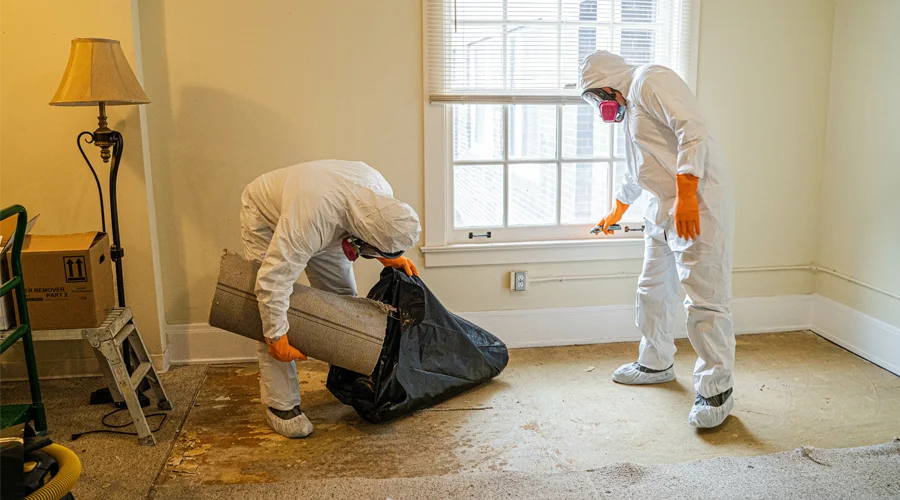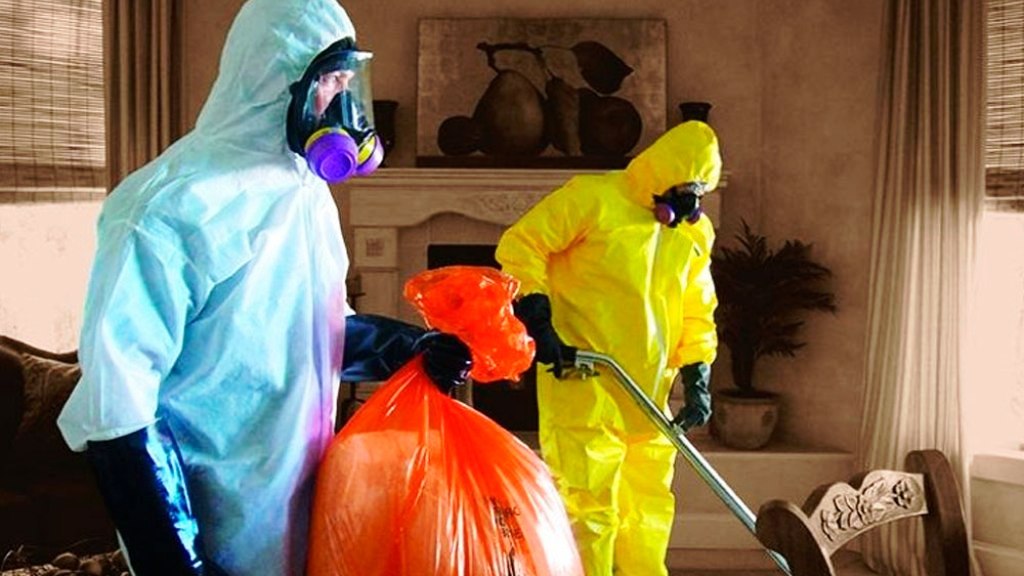
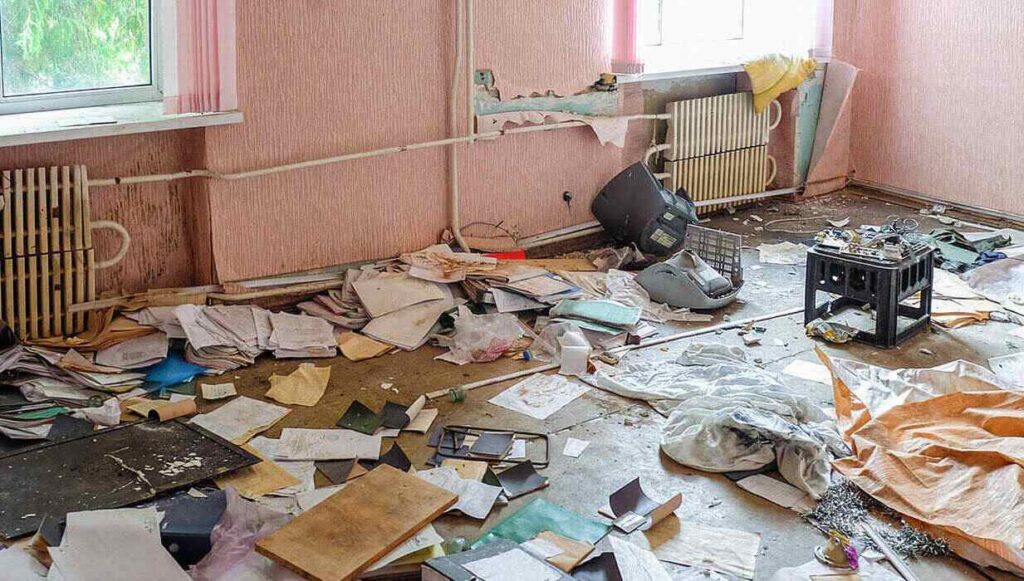
Every real estate investor and foreclosure attorney eventually inherits one of these properties. The junk removal crew shows up, opens the door, takes one look, and leaves — sometimes without even giving a quote. That property sits there costing money every single day it stays off the market, and the standard cleanup vendors in your rolodex simply aren’t equipped for what’s actually inside.
Gross filth remediation service exists precisely because there’s a massive gap between what a junk hauler handles and what a genuine biohazard crew is trained for. Banks, asset managers, and investors flipping distressed properties need to understand where that line sits, because guessing wrong on which category a property falls into wastes time, risks worker safety, and can leave contamination behind that surfaces as a much bigger liability during resale.
Junk Removal vs. True Gross Filth Remediation: Where the Line Actually Sits
This distinction matters enormously, and most people outside the industry don’t realize how sharp the boundary actually is.
Standard junk removal handles volume: furniture, boxes, general debris, items that need to be hauled away but present no biological hazard. It’s a labor and logistics problem, not a health and safety one.
A true gross filth cleanout is a different category of work entirely. It involves biological contamination severe enough to require specialized PPE, air scrubbing equipment, and in many cases, legal hazardous waste manifesting for disposal. The tell-tale signs include heavy animal waste accumulation, decomposed organic matter, extensive mold colonization, pest infestation byproducts, and porous materials so saturated with biological fluid that they’ve become a genuine health hazard rather than simply unpleasant to look at.
The practical test most experienced remediation companies use: if a crew needs respiratory protection beyond a basic dust mask to safely enter the space, and if any material inside requires disposal as regulated waste rather than standard trash, the job has crossed from junk removal into distressed property biohazard cleanup territory. Attempting to run this kind of job with a standard hauling crew doesn’t just risk their health — it typically means the contamination gets disturbed and spread rather than properly contained and removed.
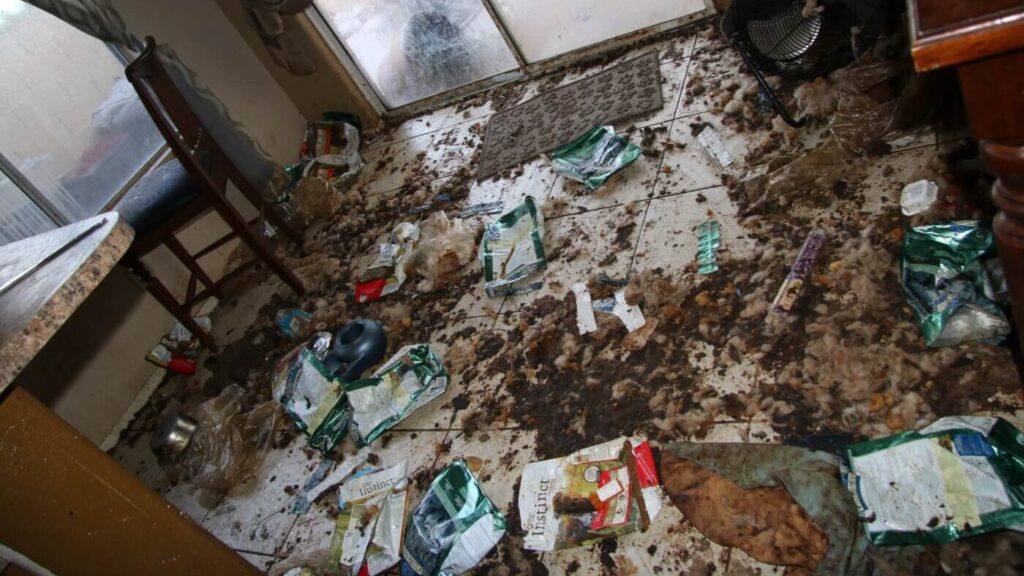
Animal Waste Cleanout and Sanitization: The Chemistry Nobody Warns You About
This is where distressed properties most commonly go wrong, and it’s worth understanding the actual chemistry involved rather than just the visible mess.
When animal urine sits on any surface, the urea it contains undergoes enzyme-catalyzed hydrolysis, breaking down and releasing ammonia gas as a byproduct. Fresh urine itself is only mildly acidic, but as bacteria decompose it over time, that ammonia release accelerates and compounds, which is exactly why long-neglected properties develop the sharp, unmistakable ammonia smell that hits you before you’re even through the front door. In enclosed, poorly ventilated spaces, ammonia concentrations can climb high enough to genuinely irritate the lungs, eyes, and skin of anyone entering unprotected, and the health risk compounds further for anyone with asthma, COPD, or other respiratory sensitivities.
The chemistry gets more stubborn from there. As urine dries, it leaves behind uric acid crystals that are essentially odorless in their dry state but reactivate the moment they’re exposed to humidity, releasing ammonia odor all over again. This is precisely why simply cleaning the surface, letting it dry, and thinking the problem is solved so often fails — the crystals are still there, waiting for the next humid day to reactivate.
Standard cleaning products make this worse rather than better in two specific ways. Ammonia-based cleaners actively reinforce the existing ammonia compounds rather than neutralizing them. And steam cleaning without enzymatic pre-treatment sets protein stains with heat and drives uric acid crystals deeper into the material rather than breaking them down. Proper animal waste cleanout and sanitization requires enzyme-based treatment first — formulations that biologically break down the uric acid and protein structures at the molecular level — followed by thorough drying, and only then any additional cleaning or sealing.

Structural Teardowns: Stripping Contamination Without Sacrificing the Building
This is the step that separates a legitimate remediation company from a demolition crew with no plan, and it’s also the step that determines whether the property comes out the other side worth what an investor paid for it.
The general rule with saturated porous materials is straightforward: if urine, biological fluid, or decomposed organic matter has soaked through carpet into the padding and reached the subfloor, surface treatment alone won’t resolve it. Carpet padding that’s absorbed repeated saturation, or that still smells after thorough enzymatic treatment, generally can’t be brought back to neutral and needs to be replaced rather than cleaned. The subfloor beneath it needs direct treatment — and in cases of dark, deep staining, that often means the affected boards need to be replaced entirely, since urine acidity breaks down the wood’s protective finish and penetrates the fibers themselves, causing warping and structural weakening that refinishing can’t reverse.
The skill in structural stripping lies in knowing exactly where to stop. A qualified crew maps contamination boundaries using UV inspection — uric acid crystals and biological residue fluoresce under blacklight even when completely invisible to the naked eye, which is how technicians identify the true extent of saturation rather than guessing based on visible staining alone. This mapping is what allows a crew to remove only what’s genuinely compromised: contaminated flooring, saturated subfloor sections, affected insulation, and drywall cut back to a clean margin beyond the visible damage line — while preserving the structural framing that gives the property its actual value.
A crew that demolishes indiscriminately out of caution, rather than mapping contamination precisely, turns a remediation project into a much more expensive reconstruction project.
For extensive whole-room or multi-room contamination — common in long-term hoarding situations or extended property vacancy — full material removal is typically the only cost-effective path forward. Trying to salvage heavily saturated carpet and padding in these cases usually costs more in labor than simply removing and replacing it.
Restoring Property Value: Getting to a Resale-Ready Air Quality Clearance
For banks, investors, and asset managers, the entire point of this process is getting the property back onto the market — which means the job isn’t actually finished until there’s documented proof the space is safe, not just visibly clean.
Beyond the visible contamination, hoarded and long-neglected properties frequently accumulate volatile organic compounds from old household products, adhesives, and materials that off-gas continuously in spaces with restricted airflow. This is why professional bank foreclosure bio recovery guide protocols always include mechanical air scrubbing using HEPA-filtered equipment running under negative air pressure, which captures airborne particulates and spores during active remediation rather than simply redistributing them through the property.
Mold is a parallel concern that gets missed constantly in distressed properties. Colonies growing inside wall cavities or beneath flooring aren’t resolved by surface cleaning or even by removing visibly moldy material — proper mold remediation, ideally performed to the IICRC S520 standard, treats the contamination as a structural issue requiring containment and specialized removal, not a cosmetic one.
The final step that actually protects the investor’s resale timeline is documentation: post-remediation testing results, structural repair records, and where applicable, a formal air-quality clearance report that can be provided to a future buyer, their inspector, or their lender. This paperwork is what turns “we cleaned it” into a defensible, marketable claim — the difference between a property that sells smoothly and one that gets re-inspected and re-negotiated after a buyer’s own contractor notices something the seller’s team missed.
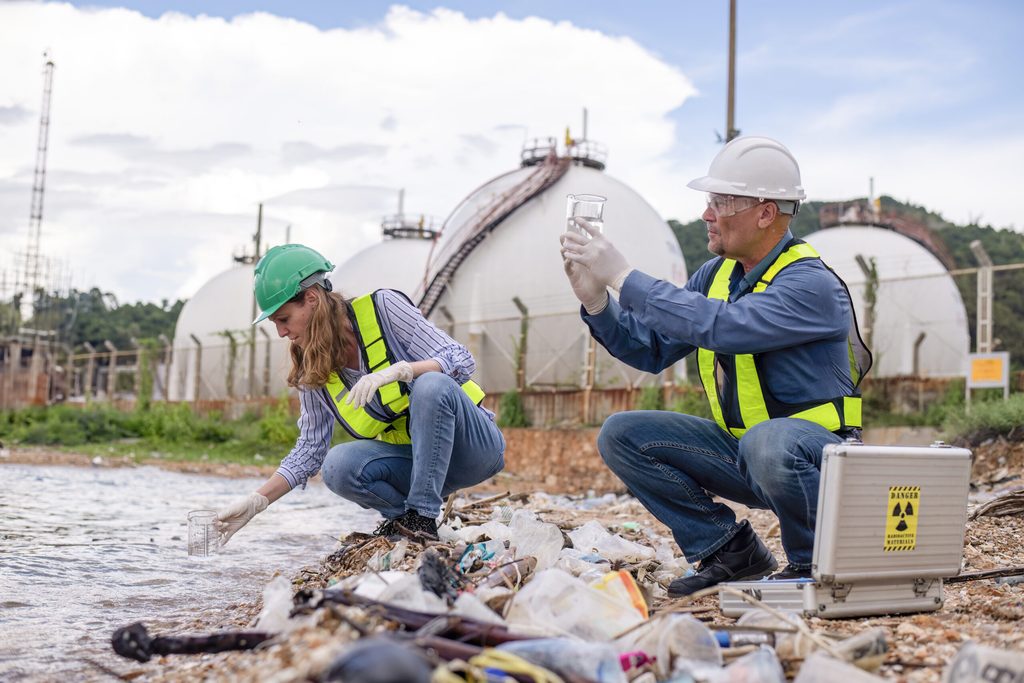
Abandoned House Hazardous Waste Cleanup: What Investors Should Expect
Vacant and abandoned properties carry their own specific complications beyond standard hoarding or animal waste cases. Extended vacancy without utilities running often means frozen or burst pipes, which introduces water damage and mold growth on top of whatever biological contamination was already present. Pest infestations tend to be more severe in long-abandoned structures, since nothing has interrupted their population growth for months or years.
Abandoned house hazardous waste cleanup also frequently involves legal complications standard cleanup doesn’t — unclaimed personal property that has to be handled according to state abandonment law before disposal, utility shutoffs that need to be verified before any work begins, and in some cases, code enforcement notices already attached to the property that carry their own compliance deadlines separate from the cleanup itself.
For investors and asset managers moving properties quickly, the practical move is treating remediation assessment as part of the initial acquisition due diligence, not a surprise discovered after closing. A property that looks like a standard fixer-upper from the listing photos can turn into a five-figure remediation job once someone actually opens the door — and knowing that risk before the purchase, rather than after, is what protects the deal’s underlying economics.
BioRecoveryPro connects real estate investors, banks, and asset managers with certified gross filth and biohazard remediation specialists experienced in structural assessment, animal waste sanitization, and the documentation needed to move distressed properties back onto the market quickly and defensibly.
The Bottom Line
The gap between junk removal and genuine gross filth remediation is where a lot of distressed property deals quietly lose money — either because an investor pays for cleanup that doesn’t actually solve the underlying contamination, or because a crew without the right training either refuses the job outright or does more structural damage than necessary trying to force their way through it.
Getting this right means understanding the chemistry of what you’re actually dealing with, mapping contamination precisely rather than demolishing indiscriminately, and finishing the job with documentation that actually protects the resale. Properties that go through this process correctly come back onto the market clean, safe, and defensible. The ones that don’t tend to surface their problems again, usually at the worst possible time in a transaction.